Sunday, May 27, 2012

A Memorial Day Art Project


Here is a fun art project that can be done for Memorial Day with patriotic colors, or for any day with other colors!  All you need is some painters tape and some paper that you can easily remove the tape from.  In our case, we had a bunch of paper that had been donated from somewhere that worked.  It looks and feels like pieces of poster board because it is stiff and glossy on one side.  The best thing to do is to try it with what you have and see what will work best.  Our pieces of paper were about 12 inches by 12 inches.

Painter's masking tape is usually blue and removes easily.

I lucked out with the painter's tape because I happened to find it at the local dollar store!  So I just bought about five rolls of it in the hopes that we would have plenty and would not run out.  My class has not yet had a chance to actually try this project out, because my volunteer didn't show up to help out on the day that we were going to do it.  But after we try it, I am going to update the blog with how many yards of tape it took to complete the project with the whole class, given that they started with a paper that was approximately 12" square.

Since I assume that the children are going to need help ripping the pieces of tape off, my intention is to have them complete this project as a one-on-one pull out to be done by a volunteer.   I have a certain volunteer that loves to do "messy" art projects, especially those that are done on a one-on-one basis, so I think that this will work out well, once her schedule works out to return to the classroom.

Anyway, I completed a few samples of my own and took pictures of the steps to be done along the way, and this is how the art project is done.  First, the child needs to tape down stripes in a random fashion as shown.

Adding the tape, step 1.
I decided to have all of the stripes on my papers "criss-cross" like an X, but I am looking forward to seeing the creative twists that they put on their own projects!


Adding the tape, step 2.

After you add the tape, it's time to start painting. 

Painting, Step 1.

I decided to paint all of the blue first, and then add in the red.  I tried to leave every other space open for the red.
 

Painting, Step 2.


I wondered what else I might be able to do to it, so I thought I might add some finger painted swirls to the blue.


Adding Finger Painted Swirls

Then it's time to add the red paint.


After that, we found that it was best to remove the tape immediately rather than let it dry.  It was harder to remove the painter's tape once the painting was dry for some reason.

Tape Removed, Project Completed!
The children watched me try a couple of samples in the classroom during their playtime, (although not this one.)   You should have heard their squeals of delight when the tape came off!  I really can't wait to let them each try it themselves!!!  I hope you have fun with it, if you choose to try it.  If you would like to see a short video of how to make this project, click here.  I posted it on my HeidiSongs Facebook page.


Friday, May 25, 2012

Pete the Cat Freebies- Guided Drawing, and More!


Pete the Cat Guided Drawing Samples From My Classroom.

Pete the Cat "fever" has swept through my classroom and indeed, my school!  All of the Kindergarten classes at my school are now reading and enjoying all of the Pete the Cat books and activities that we are finding on blogs and other places online!  So I decided to hop on the "Pete Bandwagon" and make a few of them myself.

My favorite drawing is the one with just three legs, LOL!  It's SO Kindergarten!

I haven't posted a good guided drawing lesson in quite a while, so I thought that a nice Pete the Cat guided drawing freebie would be just the ticket to help close out the school year for those of us that are still plowing our way through it!  If you are lucky enough to be all done with your school year, then you can just sit back and thumb your nose at the rest of us poor stiffs that have to keep on going.  My last day won't be until June 7th- and then one of my twin daughters, Kimmie, is getting MARRIED on June 8th!!!!  (I can hardly believe it!)  So we have been busy, busy, busy with preparations for the big day, while also trying to wrap up the school year and run our website, www.heidisongs.com.

The Bride to Be and the Mother of the Bride!

(Actually, the truth of the matter is that Kimmie hasn't given me a single thing to do to help prepare- other than pay for it, ha ha!  She and her fiancĂ© are doing every single thing themselves!)  By the way, Kimmie is the soloist that you hear on all of our HeidiSongs CD's.  I don't sing any of those solos myself.  I gave Kimmie the professional voice lessons that I never had as a child, LOL!

We do the whole cat with a black marker first, and don't pass out crayons until we are done.

But I digress!  The Pete the Cat Guided Drawing activity was lots of fun and very successful.  The kids didn't find it challenging at all, other than the shoes.  This was the first time that I had tried to do this project with the children, so of course there were a few kinks to work out.  The only real problem we had with it was that some children started out by making the head way too small, and then wound up with the whole drawing too small.  So if I were to do it again, I may just go ahead and draw the first "rainbow" line of the forehead (between the ears) lightly with a pencil ahead of time on the paper, right where it should go, making it the size it should be.  That way, everyone would be able to continue without a problem.  The issue is that once the head has been formed to small, they really can't put in the details of the eyes and nose very well, and the feet also come out too small.  That means that the legs and shoes come out very small as well, and many of the children can't make a very small shoe.  They can make a large shoe, but not a very small one.

We always do our guided drawing on the floor with clipboards in our laps.

Also, I should have given the directions for the shoes four separate times.  What I did was give the directions once, and then let them complete the other three shoes on their own.  This was perfect for the top half of the class, but not so great for the bottom!  Those children that struggle a bit more couldn't quite remember the steps to making the shoes, and just sort of scribbled their way through the rest of the shoes.  That gave them one shoe and three scribbles on the bottom of their cats' feet!  Oh, well!  Live and learn!  I am anxious to try it again and see if I can get it right next time, LOL!  In any case, click here for the free download of the Pete the Cat Guided Drawing Activity.

Download these directions to teach your students how to draw Pete the Cat!
I also made a Pete the Cat color word sheet.  I used it as a time filler for when the children finished their dictation test, and it really came in handy!  For a copy of the Pete the Cat color words sheet, click here.


The children really enjoyed the fact that I didn't put any color words on Pete himself, which left him open for any color at all.  So some of them really went crazy with it once they finished coloring the shoes!


Then I took those same drawings and made them into a patterning worksheet to help us review for our patterning test.  If you would like a copy of this patterning worksheet free download, click here.


The last thing I want to give you is this Pete the Cat Nonsense Words sheet!  My class hasn't had a chance to try it out yet, so I don't have any photos of the children's work.  But we have done several nonsense word worksheets in the past, and they have never had any trouble with them, so this one will probably also be fine, I think!  All they have to do is read the CVC word in the button and decide if it is real, or nonsense.  If it is real, they color it red.  If it is nonsense, they color it the color of their choice.  I did not put any words on Pete again, so that they could color him as they choose, just for fun!  (For more CVC words activities and worksheets, click here.  For multisensory phonics songs and activities, click here.


Click here for a copy of the Pete the Cat Nonsense Word Worksheet!  I hope you enjoy this "labor of love!"  If you have enjoyed reading this blog and like the freebies, please sign up for the email updates, and tell a friend!  I love hearing from you, too, so leave me a comment or two and tell me how you like the worksheets and activities, and tell me what you would like to see next.  And don't forget to visit our website for great Common Core teaching resources for Pre-K, K, and First Grade!

If you liked this post, you may also enjoy this one:
A Pete the Cat Freebie, and a Brand New Wiggles Book!


Friday, May 18, 2012

Teaching Kids to Count to 100

Counting to 100 is a tough skill for many little ones, but it is one that they are expected to master in the Common Core Standards for Kindergarten!  In my district, we have been expected to teach the children to do this now for many years, so this is nothing new, thankfully!  I am now down to about eight students (out of 23) that are still unable to count to 100 successfully without assistance. As I have attempted to get them to master this skill, I decided to keep track of the different things that I have done to help them and share these things with you here today.


Obviously, counting to 100 involves recognizing the hundred's chart as one giant pattern!  And I think that a lack of solid patterning skills (and probably some general readiness issues) are what is holding back some of the children in my class from reaching this milestone.  Children also need to practice this skill with an adult in a one-on-one situation, and if parents at home forget to do this, then that can also slow things down.  So the first thing that I did was test each of the children individually to see how far they could count.  Then I sent a note home to let parents know how far their children were able to count, and asking them for some help with this.  If you would like a free download of this note in both English and Spanish, please click here.


After that, I kept the list of children's names handy that were still struggling with counting to 100, and gave this list to a volunteer each time one dropped in.  I gave each volunteer a hundred's chart to show the children as they were counting, so that they could see the pattern themselves close up.  The children were pulled for extra practice in this area by my volunteers and university observers.


Then, at our math table one day, I had the children fill in the missing squares on a hundreds chart that I made that had blank spaces in the five's and ten's columns.  Over the next few days, the volunteers pulled those children that were struggling and had them try to count to 100 again while reading their charts, and then had them color in the charts, using one color for the twenties, another color for the thirties, and so on.  For a free download of this chart, please click here.


One thing that I have done each year is put some large beads on a shoe lace and write the numbers on the beads from 10-100, counting by tens.  Then, I teach the children to slide one bead over each time they finish a set of ten and move on to a new set.  I think it kind of gives them a visual representation of the pattern that they are trying to give when counting to 100.

What Comes Next?  Bingo Game

I also made a "What Comes Next?" bingo game!  The caller reads a series of numbers, such as "36, 37, 38, 39....." and then the children call out, "40!" (hopefully, anyway!) and then look for number 40 on their bingo boards and cover it up.  The game is definitely a hit!  I am including it as a free download for you this week, too!  It goes along nicely with the "What Comes Next? song on the Musical Math CD/DVD, and the "Boing!" game on the Musical Math Resource CD or the individual download with that game on it.


Of course, we have been singing the 1-100 counting song from Jumpin' Numbers and Shakin' Shapes!  Here is a video of one class from our video contest singing that song.  (The song is also on the Musical Math CD and DVD.) The "What Comes Next?" song on the Musical Math CD is also helpful in getting kids past the "nines" and on to the next group of ten.  (Example:  29, 30;  39, 40;  49-50, etc.).


The last strategy that I use when teaching the kids to count to 100 is to use their fingers to help hold their place while they are counting.  For example, I have them hold up one finger when they get to ten, and then hold up two fingers when they get to 20, and so on.  The thing that helps them the most, with this, is that they should rest the fingers that they are holding up on the edge of a table so that they don't "lose them" as they are counting, because they tend to get distracted and then their fingers relax.  As this happens, the number that they were on disappears from their hands!  So if they rest the fingers that they are holding up on the edge of a table, it seems to help quite a bit in helping them keep track of where they were in the "Big Pattern" of counting to 100. 

Pin Me to Pinterest!

Once they can see that they had four fingers raised while they were on the forties, and then they had five fingers raised for the fifties, things start to make a little more sense to them- sometimes!  In the end, the children that are ready to understand this big pattern usually get it, and those that are not, simply do not!  Right now, I still have four children out of 23 that are still struggling with comprehending it, even after all of the interventions that I have done.  Of course, there is no way of knowing how much help these children are getting at home with this particular skill, and the extra practice certainly does matter!  If I could figure out a fool proof way to get parents to practice all of these difficult skills with their children, I guess I would be a hero!

Of course, a little old fashioned motivation never hurts!  Yesterday, I was testing a child that I was confident could really count all the way to 100, after all of the extra practice we had done.  But I had to pull him for testing during playtime!  He got all the way to 79, and started to complain.  "I don't want to!  I want to play!  I can't do it"  I reassured him that I knew that he could do it, but he just kept on whining that he could not.  I told him that I was not going to let him go play until he at least attempted to tell the number that came next, but he still just sat there.  Then I had a brainstorm:  I whispered in his ear, "Hey!  If you count all the way to 100 for me, I'll give you a prize out of the prize box!"  His eyes lit up.  "Really?  Right now????"  I assured him that I would let him chose a prize today, if he did it for me.  He INSTANTLY began counting at top speed, "80, 81, 82, 83, 84, 85...." all the way up to 100!  I wanted to dance and scream all at the same time, LOL!  He got his prize, and ran off to play.  :)

Friday, May 11, 2012

Our New Classroom Management CD Is HERE- and Some Free Printables to Go With It!!!!!!


Well, we finally did it - our new Music for Classroom Management CD is finally here, and it's posted on the website!  I am so excited, because the kids and I are LOVING this CD!  And, as fate would have it, I wound up with a very difficult class this year, so having songs to review the rules has really been helpful.  God works in mysterious ways, doesn't He?  I have encountered one classroom management problem after another, and have tried to solve them musically.  The list of songs kept on growing and growing throughout the year, as I plowed my way through different situations and tried to solve them by writing songs and teaching the children to sing them.  Now I am going to tell you about a few of them!  We also are working on some visual aids to go with this CD, and we are providing you with some free downloads from it for your kids to color, just for fun!

Nobody Likes a Tattle Tale!
Is there any good solution for solving the never ending problem of tattling?  Well, my friend Tammi that I teach with told me once that when her children tattle for non-emergency reasons, she would sing out, "Nobody likes a ...." and the kids would fill in the end of the sentence with the word "tattle tale!"  So I developed that idea into a full song, and I am finding it EXTREMELY effective!  The children absolutely LOVE to sing it, and they actually seem to sometimes use that song as a weapon, I'm afraid!  As soon as somebody announces, "I'm telling!" a child will begin the chant, "Nobody likes a tattletale, Nobody likes a tattle tale!  If you tattle every day, nobody's going to want to play!"  That usually stops the tattler in his or her tracks!  Once a child made it all the way across the room during playtime while this chant when on, and then stood in front of me, ready to tell his story.  And then he stopped.  And I waited... and waited....  And then I asked him if he had something to tell me.  He said, "No, I guess not," and walked away.  Problem solved!  Gotta love it!
Here are the words to the song:

The Tattling Song

Nobody likes a tattle tale!
If you tattle every day,
Nobody’s going to want to play!
Is it dangerous?  Do tell us!  (Sung by soloist)
Is it dangerous?  Do tell us!  (Repeated by kids)
Is someone hurt?  Tell for sure!  (Sung by soloist)
Is someone hurt?  Tell for sure!  (Repeated by kids)
An emergency?  Tell us please!  (Sung by soloist)
An emergency?  Tell us please!  (Repeated by kids)
But if it’s not, be a friend!
Zip it up and that’s the end!


I have to say, that I personally would buy the CD for this song alone.  It's that effective.

Because the limbs are narrow, the kids enjoyed using colored pencils more than crayons.

Is It a Question or a Story? 
Few things drive me crazier in teaching than having a child interrupt a smoothly flowing lesson to tell me a story about something that has absolutely nothing to do with the topic at hand.  And the problem is that as soon as you give any positive reinforcement at all to the child for telling that story, you can count on at least three more hands going up to tell another.  And while those children are telling their stories, more hands go up to tell theirs.  Soon we are so far off of the topic that even the adults in the room don't remember what the objective of the lesson was supposed to be!  No wonder they want us to post it somewhere.  (Not that many children can actually READ that posted learning objective, of course, but that's another discussion!)
Enter, stage left:  my class this year, filled with very talkative children that love to tell stories and tall tales, such as, "My little sister got eaten by an alligator."  So, as I was showering one morning, it hit me:  why not make up a song to help kids decide if what they want to say is a question or a story?  (These crazy ideas for songs and activities always seem to pop into my head during the most menial, repetitive tasks of the day!)   And then the song itself also popped right into my head!  So after I got out of the shower and dried off, I wrote it down on a post-it note, and then later recorded a voice message to myself on my iPhone so that I wouldn't forget the melody.
The song goes like this: 

Question or a Story?

Is it a question or a story?
Question or a story?
That’s what I have to figure out!
Before I raise my hand!

Is it a question or a story?
Question or a story?
That’s what I have to figure out!
Before I raise my hand!

A question’s what I ask to find something out!
Find something out, find something out!
A question’s what I ask to find something out,
That I don’t understand!

A story’s what I tell about something I did,
Or what happened here,
Or what happened there!
O story’s what I tell about something I did,
When there’s extra time!

(Spoken:)  “Okay, let’s try some examples, and see if YOU can figure out if it’s a question or a story!”
(Child:)  “Can you explain that again?  I don’t understand!”
(All:)  “Question!  That’s important!”
(Child:)  “I saw you at the grocery store yesterday!”
(All:)  “Story!  That can wait!”
(Child:)  “What does that word mean?  I don’t know it!”
(All:)  “Question!  That’s important!”
(Child:)  “Today, um, is my little brother’s birthday!”
(All:)  “Story!  That can wait!”
(Child:)  “Can you help me with this?  I’m confused!”
(All:)  “Question!  That’s important!”
(Child:)  “Once I went to the zoo and I saw a tiger.”
(All:)  “Story!  That can wait!”

(Repeat from the beginning, except for the spoken middle section.)

We used Crayola Twistable pencils to color most of these!
My kids responded AMAZINGLY well to this song, and it was incredibly effective!  Now, after teaching the song, the children themselves do not let others just tell stories when they raise hands, unless I designated it as a good time to do that.  For example, I asked the children the other day if anyone had ever been to the zoo and seen an elephant, so they raised their hands and told me about it.  
Otherwise, if someone tells a story, I don't give them any positive reinforcement for it at all.  All I say is, "Story."  And then the children all say, "That can wait!"  Many times, a child will beat me to saying that, too!  But one thing that ALWAYS happens is that they all chime in with "That can wait!" no matter what!  It amazes me that it works that well.  And, often when a child asks a question, I will say, "Question!"  and the kids chime in with "That's important!"  
The only negative effect has been that the children are now thinking of unnecessary questions to ask me in the middle of lessons, just to get a chance to talk, LOL!  So I am getting questions such as, "What time is it?" in the middle of reading a book.  Or, a child will raise his hand, and then hesitate for a moment while he tries to formulate a question to ask; but the problem is that he really doesn't need to ask anything!  Argggggh!  If a child keeps doing that, I just tell the child that he is wasting our time with unnecessary questions, and I am not going to call on him or her anymore.  Some kids will do ANYTHING for attention, won't they!  (Even learn how to formulate a useless question!)


I Can Follow the Rules!
This song is for teaching the basic rules that are usually taught in an early childhood classroom.  I found it very helpful as a review of the rules, but I wish I could have taught this song in August and September! The lyrics are below:


I Can Follow the Rules

I can follow the rules, 
And we'll have a good day,
When we follow the rules!

I can listen to my teacher,
Listen to my teacher,
And I follow the rules!

I can follow the directions,
Follow the directions,
And I follow the rules!

I keep my hands to myself,
Keep my hands to myself,
And I follow the rules!

I’m always nice to everybody,
Nice to everybody,
Nice to everybody,
And I follow the rules!

It gives us more time to learn,
And more time to play,
More time for fun stuff every day!
It gives us more time to learn,
And more time to play,
More time for fun stuff every day!
When we follow the rules at school,
Oh, yeah!
When we follow the rules at school.
OH, YEAH!


When I first wrote this song, I hadn't thought about including the reasons for following the rules.  But I do have a couple of little ones with very late fall birthdays that have had a difficult time internalizing and following the rules.  I began to wonder if the children really understood the reasons why we have rules at all, other than to spoil their fun!  So that's when I changed the lyrics and threw in the words, "And we'll have a good day, when we follow the rules!"  I also added the ending section about having more time for learning, playing, and having fun when we follow the rules.  Ironically, I now have a video tape with one of my little cuties being VERY naughty during this song, LOL!   Too bad I can't show you that one, ha ha!  One thing for sure is that the children need to be motivated (and able!) to follow those rules, or the song itself isn't going to help very much!  And it sure doesn't turn a child that is four and a half years old into one that is six!  (Okay, if we can't medicate the children, then how about ME, LOL?)


Here are some quick notes on the other songs, just in case you are interested!

The  Backpack Boogie
This song is for teaching the procedures for coming inside in the morning, putting things away, and getting settled.  This has been a challenge for my group this year, since many of them would much rather socialize and wander about the classroom rather than put their things away and have a seat!  Unfortunately, this song came too late in the year for it to really do me much good.  I think it would have helped a lot more at the beginning of the year.  I am looking forward to starting out the year with it in August.

When the Bell Rings, Freeze!
My kids adore this song!  It's fun and quick, and they LOVE to dance and then freeze when the bell rings!  It's a great way to reinforce what we do when the bell rings- FREEEEEEEZE!  Stop!  Hands up!

Interrupting
This is one of my personal favorites!  In fact, I'm thinking of writing another Wiggles book that deals exclusively with interrupting, using this song as a refrain in the book!  It goes, "Interrupting is very disrupting.  Don't start squawking when someone else is talking!"  And that's the whole song!  We just sing it several times through.  Now when my kids interrupt in class, I often just start singing this song, and the rest of the class joins in.

Outside Voices, Inside Voices
I have to say, that I have never had a LOUDER class in all of my teaching career!  One child's voice elevates, and then another, and then another, and then the whole class is louder than a circus!  So this class was the TOTAL motivation for this song:
Outside voices inside make it hard for us to learn!  Screaming’s not okay!  Screaming’s not okay!... The song goes on to have the children practice using outside voices, inside voices, and whispers, so that they can hear and feel the difference.  

Cover Your Mouth and Blow Your Nose
These two songs are wonderful for teaching kids these basic skills for hygiene that will all NEED in order to stay healthy.  I particularly like the "Blow Your Nose" song because it not only addresses why to blow, but HOW to blow your nose, (by taking a breath, closing the mouth, and blowing the air out through the nose like a dragon!)  The kids like it because it is "The Dragon Song," to them!

Potty, Potty, Flush, Flush... & The Potty Dance!
At the beginning of the school year, I was trying to get the children to follow the rules in the restroom (without a lot of success, I might add!)  Later on, I came up with this little song, and the kids now LOVE to sing it together during their playtime, LOL!  Then a co-teacher mentioned that she simply couldn't believe that a five year old child could be standing there- doing the potty dance- and not know that he needed to go to the bathroom!  So I came up with The Potty Dance, which reminds them that "When you're doing the potty dance, it's time to go!"  They all find that hilarious!  And I really love watching them enjoy it!  They are just so stinkin' cute (pun totally intended!)

Snap That Cap
This song is for reminding children to replace the cap on a marker when they are done using it.  Enough said?  :)

The Smarty Pants Dance
This song is a "victory dance" for when kids finally "get it!"  My students simply LOVE it for the catchy beat and the opportunity to shake their little booties!  Just check out how much fun we had recording it in this video clip of the "HeidiSongs Singers" in the recording studio!  It was SOOOO much fun!


Line Up
This song is for teaching the rules while walking in line.  My kids love to chant it while we walk to lunch and the library.  That doesn't mean that they actually follow those rules while they chant it, but hey- I can keep trying, right?

We Don’t Fight!
This is the same song that is on Sing and Spell Vol. 5 as the "Fight" spelling song.  The lyrics were designed to be used as either a spelling song or a conflict resolution song.  So this one serves a dual purpose!  Use it well.
 
And I think that the rest of the titles speak for themselves!  
If you would like to download the full lyrics and handmotions, please click here and scroll all the way to the bottom of the page.

Please and Thank You
Right Hand, Left Hand
Red, White. and Blue
The Days of the Week
Months of the Year
Criss Cross, Applesauce
The Tracing Song
The Cutting Song
The Glue Song
Just Try Your Best
I Love My Lunchbox


Sunday, May 6, 2012

Making LIFE SIZE Zoo Animals- and a HeidiSongs Promo Code!


The snake was so long that it was difficult to photograph!
These are the completed snakes.  You can see the loft stairs below!
This week, I created some giant zoo animals out of butcher paper for my kids to paint!  So I am going to tell you a little bit about how I did that, and then let the pictures tell the rest of the story.

Meanwhile, here is a HeidiSongs promo code for Teacher Appreciation Week!  The code Teach20 will get you 20% off of a purchase of $20 or more.  I hope that this will help a few of you out!  It expires on Sunday, May 13, 2012 at midnight.

To create the animals, I just took the patterns from the Zoo Book that is on our website and basically multiplied the size times five!  So if the pattern called for a five inch square for the head of an animal, I cut out a 25 inch square, and then cut off the corners as usual!  As far as the patterns were concerned, such as for the head of the alligator, I had to just sort of sketch it out myself because I couldn't possibly enlarge the pattern on the xerox machine to that size!  So I just "eyeballed it" and took my best guess, figuring that it needed to look a little childish anyway, and it worked out just fine!  When I was finished putting the animal together, I took another look at it, and if a body part appeared to be a bit too large, I trimmed it down a bit until it looked right.

This is how I cut out the leopard.
Once I had all of the animals cut out, I taped the pieces together with scotch tape!  I was able to glue some parts, but I taped others, depending on what I thought would hold the best.  Also, I doubled the smaller pieces for strength and durability because I wanted to be able to hang these animals up on the classroom walls.  So I doubled the pieces for the legs, ears, and tails, etc.

I folded and doubled the paper for the legs, ears, and tails.
My classroom has some VERY high ceilings, so it can be tough to try to cover all of it for Open House, so these giant animals come in very handy for covering large spaces in one shot.  But I also value them because they require that the children work together nicely to paint the animal.  Most of them require some persistence, too, because it can take a while to paint a large animal shape, and it can be a little tiresome for them when it is all one color!  So they have to really stick with it and work together to finish it.  That's hard for some of them!

The kids painted the background color, and then added the details when it was dry.


I painted the face for them, but the children painted the claws and spots.

Overall, this was a really fun project for them, but it took me quite a while to cut out the animals and tape them together.  It took me about a half an hour per animal from start to finish just to cut them out and get each one ready.  The snakes took much less time, though, because they are simpler.  We did pencil in the lines so that the children would know where to paint, and then assigned each child a color to paint.  Sometimes we just write the color word right in there so that they know exactly where to paint!  The other animals were harder to cut out, but simpler to paint because they were all one color, such as the crocodile below.


Pin me to Pinterest!

A great book to read with this is Actual Size.  It is also a great time for the children to measure the animals and discuss if we really managed to make the animals close to their actual size.  (Hint:  Most of them were still too small!)

This a great book to read to the children with this project!
Here's some management tips for you, if you decide to do this project.
1.  Have an extra volunteer or two on hand to help.
2.  Tape down the animals outside on the concrete so that you can let the children paint them freely, and then they can go right off the edge without worry.  It leaves an interesting painted mark on the concrete that tends to look a bit like a zoo animal crime scene, LOL!


Friday, May 4, 2012

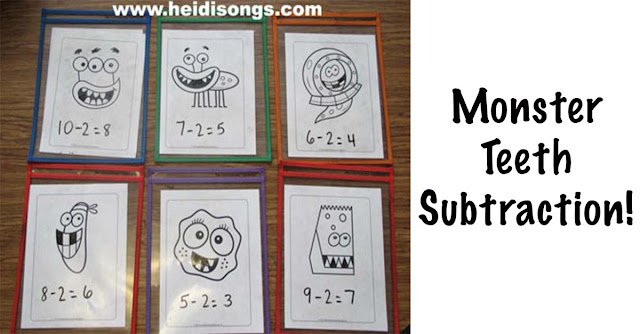
Monster Teeth Subtraction! And a Brand New HeidiSongs Subtraction Book!


Today I am going to tell you about a resource that I have really fallen in love with... our newest creation, called Counting Creatures Subtraction Worksheets!  And one really fun part of this book is the part of it that is a lot like my recent post on Loose Tooth Subtraction, except this one has the loose teeth on MONSTERS! 
By the way, since Teacher Appreciation Week is coming up so soon, we are giving you a promo code, good just for the week on our website!  The code Teach20 will get you 20% off of any order of $20 or more!  That's better than a free shipping code for the larger orders, and just about the same as a free shipping code for the smaller ones.  This offer expires at midnight on Sunday, May 13, so enjoy!

We have been working on developing this new subtraction book over the last couple of months, and I have been trying it out in my classroom, of course.  The children really love the monster theme of these worksheets, and they love coloring in those monsters when they are done with their work!  But the BEST thing about them is that my kids passed their official subtraction test for the report card this week with flying colors, and I would have to say that these are the best results on a subtraction test that I have had in years!  I think it is because they are so excited about the activity, and got so much good practice doing it.

Roll a die to figure out how many teeth to black out.
 
This is how the Monster Teeth Subtraction activity works.  There are six different monsters, with a different number of teeth in each mouth.  You roll a die or spin a spinner to see how many teeth you will black out, and then write an equation to match the picture.  For example, in the picture above, the monster had eight teeth.  The child rolled a die that came up with a number four, so he colored in four teeth.  Then he wrote the equation, "8 - 4 = 4."


For my class, we had been doing subtraction for a while, and I decided that the children were up for a little bit more of a challenge than just having all of the children do the very same monster and equation at the same time.  SO.... I decided to try it this way:  I gave each child in the group a different monster, (with a different number of teeth in each one.)  Then someone in the group spun a spinner, and everybody in the group wrote a different equation based on that number.  So if we rolled a two, then a child with a monster that had seven teeth would write "7 - 2 = 5."  But the child next to him had a different number of teeth in his or her monster, so his first number would be different!  If he had a monster with ten teeth, then his equation would be "10 - 2 = 8."  The only number in common was the minuend (the second number in the equation.)

As a follow up, each child did the corresponding worksheet on the back.
The reason why I like this as a small group activity is that it is impossible for the children to copy each other's equations!  They HAD to think for themselves and write their own equations.  It really was a wonderful activity!  As a follow up, the children then flipped their dry erase sleeves over and did the worksheet that corresponded to their own monster.  Later on, I gave the children an opportunity to do the worksheets again with crayons, with plenty of time to color them as they liked, since this was such a favorite activity. 

Here are some examples of the children's work done with crayons.
There is another great thing that I really like about the subtraction book in general.  Each page is marked with a guide that says, "Differences from 7" or "Differences from 10," etc.  That tells me exactly what types of equations I will find on each page.  I discovered this week that I could give them a whole variety of monster worksheets to pick from, and still have them essentially be doing the very same worksheet!


Here's what happened:  Since we were at the end of our subtraction unit, I knew that I had more worksheets than I would ever truly need.  So I decided that I would go through the workbook pages on my computer and just print a variety of worksheets- just maybe three or four of each one, but stick with differences from nine, for example.  That way, everyone would be getting the same equations, but would still feel like they had some control over what they were going to work on, and what they might like to color if they finish it in a timely manner.  I just made sure that I printed enough for the whole class, plus a couple of extras.


When I was printing them out, I had the feeling that it was going to be a little bit "risky."  What if one child wanted one that ran out?  Would he or she have a little "fit?"  I was pleased to find that none of that happened!  The children were exceedingly happy with the idea of actually getting to CHOSE what they were going to do in math, because that NEVER happens, LOL!  WOW.  I can't believe that I had never thought of that before!  (Duh!)  I really should have done that with the Counting Creature Addition Worksheets, too, since they are set up exactly the same way!  (Double Duh!)  I don't know why I never thought of that before.  It's the perfect solution for children that need to feel that they have ownership in their day, and who like to believe that they are in control- but they're not!  :)  By the way, if you missed my blog post on the Counting Creature Addition Worksheets, along with the free sample for that package, click here


The other thing that I think really helps about these worksheets is that there are usually only about six equations per page, and there are never more than ten!  That means that the average child can easily finish their work on these pages in a reasonable amount of time without becoming overwhelmed.  If you would like to try a few of these subtraction worksheets FREE, then click here.  If you want to purchase a just some of them or all of them, click hereThey are sold in downloadable packets of about 15 worksheets each for $3.00, (except the last packet has 27 pages and it is $5.00).  Or, you can get all 85 pages as a download for $12.00.


Want some music to go with this?  The Addition and Subtraction Songs on the Musical Math CD and DVD are really fun ones that my kids love!  Check it out here