Monday, August 29, 2011

Extra, Extra! Sight Word String-Ups!

These are Sight Word String-Ups!  I use these quite a bit in my classroom, and my kids always enjoy using them.  I'm posting this "mini-blog" early in the week because these plastic pencil boxes that I use to make these Sight Word String-Ups are on sale this week at Office Depot for just one penny each (at least in my area, anyway!  You'll have to check with your local store, of course, if you want to make some.  You may also want to call and find out if they still have any left in stock, because at least where I live, they run out of this item every year when they put them on sale for a penny.  The teachers all snap them up right away!  Our local Office Depot allows teachers to buy up to 30 items each if you have one of their teacher cards.  However, I understand that not every store follows this policy, so check with your local store before investing time or money in the project, for sure.

The "REAL" Sight Words String Ups Set
I refer to these Sight Word String-Ups often in my presentations because it is a favorite activity of mine!  Recently, I received an email from someone that was a participant in one of my sessions last year and was looking for a blog post on them, and it was then that I realized that I had never written one!  (Duh!)  So here it is:
Sight Word String-Ups are actually a kit that is sold on Amazon.  It comes with four trays, a bag of letter beads, some pipe cleaners, and a bunch of flashcards.   I gave up on using their trays a long time ago, because four trays is not enough for my small groups, so I just use the beads and pipe cleaners.  I also use my own flashcards, because that way we only wind up working on the words I consider to be the most important.

If you decide to purchase only the letter beads as I did, here is a link to them on Amazon, though I got mine from ReallyGoodStuff.com as well.   Unfortunately, Really Good Stuff has now discontinued this item.  I got the foam self-adhesive on letters on the boxes from Discount School Supply.
All I did was put the letters for each word in a pencil box, along with a pipe cleaner purchased from Michael's.  (One year, I also put in Unifix cubes with letters on them as you see in the picture, but it proved to be somewhat confusing so I took those out.)   Then I put the foam letters for each word on the top of the box.  I ran out of a couple of the vowels and had to make a couple of  e's out of c's, and so on, after I hit box number thirty or so.  So you might want to buy more than one bag of letters if that bothers you.  After I had decided to make 50 boxes of them (since my district increased the number of words required,) and I did go back and reorder some.  I also made a few boxes with the children's names on them for some struggling students that had a terrible time learning the alphabet, because I decided it would help them learn the letters in their names to start with.  But in this case, I just taped a paper with their name on it rather than putting the foam stickers on the pencil box since it would be only temporarily used.  Of course, THEN I had to order an entire bag of upper case letters just so that we could practice stringing our names- and that was a whole bag of letters of them I had to buy when I only a few!  Go ahead- say it:  Been there, done that!  (The foam stickers do leave a lot of bumpy residue if you try to remove them, so it is best to think of these letters as permanent once you decide to place them on the box.

Have fun with them if you decide to make some, and I'll be posting more at the end of the week!
Heidi


Friday, August 26, 2011

Week One: Wiggles Learns the Rules at School, The Homework Bell, Calendar Book Updates, and More!


Phew! One week down, 41 more to go! The first week of school seems to be the most stressful week of all as we establish routines and get to know our new students. But for some reason, this year has been much less stressful than it normally is- (and I praise the good Lord in heaven for that!) I have no explanation other than the blessings of prayer! I actually can’t remember having such a smooth and stress-free start to a school year. I did wind up with about 15 requests from siblings of former students, and that sort of thing, and that always really helps take the stress off, I think.  I LOVE those repeat "customers!!!!"  As I looked around at the group of parents that came to my parent orientation meeting, there were so many familiar faces that it seemed very comfortable and easy. I sent them all home that night with a DVD, and I know that some of the children must have watched their new teacher on television when their parents got home, because a few of them had “stars in their eyes” when they entered the classroom the next morning, and gazed at me with this “I saw you on TV!” look on their faces! (That always makes me chuckle!) One of them even remembered to thank me for the DVD, which I thought was sweet.
At the moment, I have 23 students, and most of the crying at the AM drop-off has stopped. (Hooray!) Yesterday when we watched a part of the Singable Songs for Letters and Sounds DVD, I heard one child say, “Hey, teacher! That lady looks a lot like YOU!!!!” Amazingly, none of the other children pointed out that the lady on the screen actually IS me, LOL!  Last year, a mom told me that her son said that the lady on the screen couldn't be his teacher because the one on the screen is much younger!  :)


1. INTRODUCING: Wiggles Learns the Rules at School!
Well, I did it. I set a goal for myself of making a children’s story book to help children learn the rules at school, and the book is now finished! We hired an illustrator for this one, because there was no way I could find the time to illustrate this one myself. And I LOVE the way it came out! We sent the illustrator some pictures of me in my classroom with my students, and also some pictures of the playground. The funny thing is that the teacher in the book actually looks like me- (on a good hair day, anyway!) I also recognize some of our toys in the classroom and some elements of our playground. We also sent her some pictures of our dog Jasper to copy, and she did just that- but added some spots to make the dog more fun to color. So now I have an illustrated story book with pictures of me, my students, and my cute little dog that is posing as one of my students, trying to learn the rules! This is WAY too much fun!!!!
Heidi and the "Real" Wiggles!
Anyway, my students are just LOVING the book! I have a big, fuzzy Melissa and Doug dog puppet that I bought a few years ago, and I have been having the dog act out the story as I read it, and talking to the dog about the rules. The children love chiming in with the repetitive text, and laughing at the silly dog, who forgets the rules each and every day. Every single day so far we have read the book and enjoyed it to the fullest. The children don’t realize it, but this is how we have been learning the rules in our classroom. We actually haven’t done any other formal lessons as far as school rules are concerned, and the kids are generally doing very well so far in following them, so I think it must be working!
(Maybe this accounts for some of the reduction in stress I am feeling?  Who knows?)
Some time next week, the children are going to make a paper bag puppet to go with the book. (The download of the book includes the pattern for this puppet.) They are not very proficient at cutting yet, so we’ll probably do it with our book buddies so that they will each have a helper to go around the head. I know that they are going to love it! There's also a student sized copy of the book for kids to color and take home that is a part of the download, and we'll be making one of these soon, too.  I'll have the children look for certain letters and/or words in it, such as the word "the" and highlight it each time they find it, so that it will double as a reading activity as well.  Fun!
2. The Homework Bell!
Here’s an idea that I am going to try! Do you have students that do the homework but seem to have no interest in turning it in? I always seem to have about six or seven little ones to whom it never occurs that it might be a good idea to look for that piece of paper and put it in the homework box, no matter how much I beg or plead. (At my school, the vast majority of the Kindergartner’s parents make them do the homework, but they often forget to turn it in.) So I have decided that this year I am going to encourage my students to turn in the homework that is surely sitting in their binders (See my blog on this topic here) by allowing them to ring a bell when they put it in the basket. I’m thinking of using a Staple’s “That Was Easy!” button for a little while, at least until they get tired of it. Then I’ll think of another bell or button for them to push. I’m keeping my fingers crossed that it will at LEAST help encourage them to pull it out of their backpacks and turn it in! Wish me luck!

3. Spinzone Magnetic Whiteboard Spinner
I found this Spinner at the Learning Shop exhibit booth at I Teach K. They also run a mail order teacher supply company. The owners, Dave and Doris, are a very nice retired couple that run their business by following many of the SDE conferences and exhibiting at them if it is not too far from their home in Indiana. Dave and I have gotten to know each other over the past year, and when he saw me, he asked if I had seen the new spinners that he had in stock. I replied that I had not, so I went over to take a look.
The spinner is a very simple design with just a bolt glued onto the back of it, which is attached to a magnet on a spinner. So you can place it on a magnetic whiteboard and it will stick, and then give it a spin. After drawing the rest of the spinner “fields” on your whiteboard, it can be used like any spinner. If you would like to see a little video of this spinner in action, just check my HeidiSongs Facebook page! It’s pretty neat. I noticed that on Amazon, they sell these spinners in packs of three for $19.99.  I can’t imagine what they were thinking of; what teacher is going to need three of them when you can clearly only ever use one at a time?  Some of the sellers on Amazon and also my friend Dave at The Learning Shop has split them up into singles and only charges $7.99 plus shipping for each one. I don’t know what he charges for the shipping, but the spinners are light so it couldn’t be much. If you want to order one, you can fax them an order at 1. 317.842.1723 or call them at 1.800.369.6792.

4. Calendar Book Files Updated!
If you are doing the calendar book in your classroom and have been waiting for the updated "Write the Date" files, here they are! If you are new to calendar books, then click on the link below for more information. It is something that I sometimes do in the spring with my class when we start going full day, depending on how well my students are able to focus and cooperate in whole group situations. Click here to read a previous blog entry on how I have used calendar books in previous years.

Friday, August 19, 2011

More Projects for the Beginning of the School Year, and Declaring War on Glue Bottles!

Well, I have spent this week getting my room ready for school to start on Monday, and going to meetings.  This is what I have learned:
1.  The ideal curriculum is the one that comes with only one teacher’s manual and zero boxes of supplies that must be stored in my room for the next seven years.
2.  There must be dozens of places to set a stapler down in a classroom.  I have left my stapler in all of them, and then spent a good five to ten minutes searching for it each time.
3.  Papering a bulletin board with a thermostat in the middle of it takes at least twice as long as papering one without it, even if it is much smaller than the rest.  (For some unknown reason, our district builders decided that the most logical place to put the thermostat was in the middle of the bulletin board after we went through our renovation a couple of years ago.)
4.  It only takes our district a few hours to patch up a window that has been shot out by a bullet, and only one more day to replace it!  (It was probably just a BB gun.  I hope no one was aiming at ME!)
5.  I would rather be in Hawaii!

So it has been an eventful week!  But my window is repaired, my air conditioning still works, I finally have my class list, most (but not all) of my friends are still employed and so am I, and I am looking forward to meeting my new students on Monday!  And now here are some more beginning of the year projects that I have been prepping.  They are very simple and easy to make.  But I am going to start with some tips on getting your glue bottles ready to go!

1.  Declaring WAR on Glue!
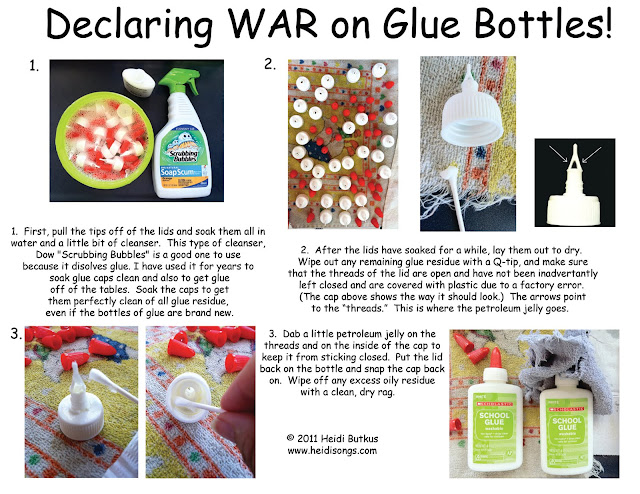
Few things are more frustrating than having a great project ready to go, and then having it derailed by a bunch continuously clogged glue bottles.  One of the readers on my HeidiSongs Facebook page commented, “Glue is the arch-nemesis of Kindergarten!”  So I decided to do some research on how to make those glue bottles keep from clogging up.  I found that if you remove the small caps on the very top, and spray them with Pam cooking spray, the glue does not stick to them.  I also learned that if you coat the “threads” of the lid with petroleum jelly before replacing the small cap, the glue will not stick to those, either.  BUT- it makes sense to me that the glue lids must be completely clean first in order for this to work, so I decided to soak them in cleanser before beginning.  I used a mixture of water and a little bit of the liquid “Scrubbing Bubbles” cleanser.  For the rest of the procedure, see the picture.  If you would like to download it so that you can print it out, read it, and save the directions, click here.  
As a side note, this "Scrubbing Bubbles" brand cleanser works great to dissolve glue off of tables.  Just spray it on and let it set for three to five minutes.  Sometimes, I spray a little water on the table as well.  Then I use a scraper that I bought at Home Depot, and all of the glue just slides right off as easy as pie.

As I was trying to figure out how to do this and discussing it on my Facebook page, there was a little bit of teasing going on, with people saying they were worried about me and my obsession with glue as I posted my pictures, etc.  It was pretty funny.   My posts kept finishing with the phrase, "Stay tuned..." because I was still trying to figure out how it would go.  But the conversation culminated in this quote from Erin Lyons, which I thought was absolutely HILARIOUS:  "I have an imaginary video running in my head. Close your eyes and join me: It's the first project in Heidi's class.  "The children are about to squeeze "just a dot (not a lot!)." Suddenly, chaos breaks out when projectiles shoot across the room from the highly-lubed glue caps, and children become part of an unintentional, but hugely creative mass-media sculpture formed of tissue paper, hair, furniture, carpeting, pom-poms, clothing, and pipe cleaners. I AM staying tuned... glued to my seat!"  When I read that one, I nearly fell out of my chair laughing!  Good one, Erin!!!  That's MY kind of sense of humor!!!

Also, the conversation also inspired another reader, Krissy Miner, to create another free download which she posted on Teachers Pay Teachers!  It is called "Top Secret Gluing Techniques for Beginning Gluers."  I think what she has here is a great idea, because she's got the children practicing making small glue dots and glue frames ONLY- they are not actually gluing things down at all!  They are just practicing squeezing out the small amounts of glue.  This makes sense because what we should do when teaching is do a task analysis:  That is, break down a task into the smallest possible steps, and teach each one.  When you skip a step, or assume that they know it, that is where the problems arise.  But I never thought about thinking of the gluing part as a separate skill.  Bravo, Krissy!!!!

There are also lots of little rhymes out there, I've discovered that while helping children remember how much glue to use.  I came up with one myself!  I am planning on recording it as part of a Classroom Management CD that so far at least, exists only in my dreams and in the shower!  But here is the "Glue Song!  (Sorry, I don't have a tune yet.)

Heidi's Glue Song  
(© Heidi Butkus 2011)

Just a dot, not a lot!  One dot!


2.  Traffic Light
The traffic light is part of our unit on safety.   When we make it, we also read books about signs around town and safety when on the way to and from school, etc.  It is very simple to prepare and does not require any patterns.  Each child needs the following construction paper cut:
1 black rectangle  6” x 9”
1 yellow square  3” x 3”
1 red square  3” x 3”
1 green square  3” x 3”

To make the traffic light, show the children how to round the corners off of the colored squares to form circles.  I always have them sing me the color songs from Sing and Spell Vol. 2 while we cut.  Then point out to them that they do not need to cut the black rectangle at all, but they will need to think about where to glue each colored circle.  Red goes on top; green is on the bottom, and yellow is in the middle.  To help them remember, consider singing this simple song, sung to the tune of “Twinkle, Twinkle, Little Star:”  You may even wish to print out the words to the song and have them glue these lyrics onto the back of the light.

The traffic lights we see ahead are sometimes green and sometimes red!
Red on top and green below!
Red means stop and green means go!
Yellow means wait- even if you’re late!
The traffic lights we see ahead are sometimes green and sometimes red!

3.  Stop Sign
The stop sign is another project that I always do with our unit on safety.  All you do with this one is copy the sign on red construction paper and then have the children try to color in the letters of the sign with a white crayon and cut the whole thing out.  Then they glue it on to a tongue depressor and have fun holding it up and saying, “STOP!!!!!” to each other for the rest of the day!  The Octagon Song is also a natural for this project, as well!  It's from Jumpin' Numbers and Shakin' ShapesFor the master, click here.

4.  September Calendar
All of the Kindergarten classes at my school have the children make a calendar at the beginning of each month, and this is the calendar that we will be making for September.  To make it, the children take some large shape stencils that we have had “forever” (sorry, I don’t know where they came from!) and they use these to draw whatever shapes they like with crayons.  We usually sing the shape songs from Jumpin' Numbers and Shakin' Shapes while I demonstrate the tracing of them.   The large colored shapes are pre-cut for the children out of different colored pieces of tissue paper, and they can glue them down wherever they like.  Sometimes, we also give them a small amount of water to paint over the top to make the colors bleed.  Later, you can remove the tissue paper when it tries to see what the remaining paper looks like without it- but I really like the way it turns out best when you leave the tissue paper on, so we don’t do that anymore.

Saturday, August 13, 2011

Collecting Kindergarten Portfolio Samples, and the What to do the First Week of School

Heidi and Her Husband Greg in Maui, Hawaii

That speck at the bottom is Greg!
Last week, my husband and I were blessed enough to spend a wonderful week on the beautiful island of Maui, Hawaii!  We hadn’t been there in many years, and enjoyed it thoroughly.  But like all good things, the wonderful summer and our beautiful vacation had to end, and now it is back to work!   I already spent my first day back in the classroom trying to push the furniture back into place after all of the cleaning that was done over the summer.  The cubbies and storage units for the toys and supplies are such heavy pieces of furniture, and they always seem to wind up on the opposite side of the room from where they belong.  Luckily, I managed to round up our very helpful new custodian and his assistant, who spent 25 minutes helping me move it all back into place. For some reason, my classroom also received the high honor of becoming the dumping ground for all of the furniture and supplies that were moved out of the kindergarten foyer and kitchen, so I had to move all of that back into place as well.  The air conditioner in my classroom broke sometime over the summer, so it was just a little hot in there, but miraculously there was already a repairman there this morning fixing it!  So now I am saying good-bye to the summer and Getting Ready for the Inevitable:  a new school year- (hooray!) and tons of work (boo!).  I guess when the going gets rough, I'll keep looking at these gorgeous photos!  Aren't they beautiful?

And so... here we go!  Our first day back for teachers is on Wednesday, August 17, and then school starts August 22.  We are experimenting this year with having the meeting that we usually have with the parents on the first day of school on the SUNDAY night before school starts from 4:00 to 6:00!  So I am really hoping that this will ease up the pressure of having all of those parents AND children there on the first day of school together at the same time.  That way, the parents should be able to drop the children off and go- hopefully!  We’ll see how it goes.  In any case, if you would like to see what I do on my first day of school, please see my blog entry on Aug. 10, 2008.  I do pretty much the same thing each year!  I thought I would blog this time on what I do during the rest of the first week of school as well.  I hope it is useful to you!

1.  Kindergarten Portfolio Samples
Each year during the first two weeks of school, the teachers at my school and I have always faithfully collected portfolio samples to help document the children’s entry level abilities as far as written work is concerned.  These portfolio samples are taken again at the end of each trimester and shown at parent conferences.  I always find this extremely helpful in conferencing with parents later in the year, especially at the conference that takes place at the end of the first trimester.  It is particularly important for the parents of the children that are truly struggling, because sometimes, the only notable progress that can be clearly seen is in that of fine motor skills!  Because we always have a few children that have never had any preschool experiences and few literacy experiences at home, it is nice to have something to show parents of these children that can almost always show a dramatic improvement in just a few months time.  Children from backgrounds such as these often have never even held a pencil or a pair of scissors before, and so if you can document their beginning struggles as they make their first attempts to copy even a single letter, and then show their parents how far they have come, you will surely look like the hard working teacher that you really are!  And THEN- even if they have only learned half of the alphabet after all of your hard work-(God FORBID!)- you will still be able to genuinely praise the child for some real growth, and that feels good for both parent AND child!  (I like this because the children are expected to attend the conferences with the parents at our school, and it’s hard when there isn't a lot of good news.)
Alphabet Copy Entry Level Sample


Our Kindergarten portfolio includes:
1.  Alphabet Copy- (capitals and lower case)
2.  Number Copy- (1-30)
3.  Name Writing- (from memory, and they must do the first and last name on lines by the end of the year.)
4.  Visual Perception Shape Copying Exercises- (Two pages- one simpler, one harder)
5.  A Self Portrait
6.  A Writing Sample
7.  A Coloring, Cutting, and Tracing Sample (Use any that you have)


Shape Copy Entry Level Sample
I have recreated each of these pages that our district uses so that I can them to you here today.  The copies I have been using for years were hand drawn by a retired teacher and are copies of old copies, and are in terrible shape!  So it will be good to have some nice, professional looking portfolio pages of my own to use now as well.  I especially enjoy seeing the children's progress in how they are able to copy the Visual Perception Shapes.  At the beginning of the year, only a few children are crossing the midline and are able to make the most complicated shapes.  But as their visual perception and fine motor skills improve, there is an immense improvement in what they are able to accomplish on this.  Also, if you try them all, you will notice that at the beginning of the year, these tasks take some of the children quite a long time, and some of them may not even be able to finish.  But by the end of the year, they are whizzing through them in no time flat!  So it really is a fun thing to watch as a progression, especially if you are at all interested in child development.

Name Writing Sample
Just so you know, as a management technique, we usually xerox the pages in sets of four, all stapled together at the beginning of the year with the dates already on them.  So for example, before school starts, each student will have a packet of four Lower Case Alphabet Copy papers stapled together.  The top copy says “Entry Level” on the date; the second says, “First Trimester;”  the third says “Second Trimester;” and the fourth says “Third Trimester.”  And it is the same for each and every one of these pages; they are all copied and stapled into sets of four with the approximate dates already on them, just for the sake of expediency.  Then, all I have to do is pass them out and make sure that EVERYONE gets their name on them! 
Also, when the children have to do the name writing paper, they CANNOT copy their name at all.  They HAVE to do it from memory.   You may have to take away their name tags, if you use any!  And be careful when you pass out the name papers again at the end of the first trimester, because they may realize that they really “blew it” at the beginning of the school year and try to erase it and fix it after the fact.  If they are unable to write their names at all at the beginning of the year, you'll have to note the child's name on the back of the paper, obviously, or the child will copy it.  OR... they may just copy it exactly the way the did it at the beginning of the year- completely wrong AGAIN!  So I usually give this test to them individually and simply cover up the name sample that they wrote at the beginning of the year with another piece of paper. 

Self Portrait Entry Level Sample
I always feel a bit awkward when I give the children the Writing Sample page at the beginning of the year, because almost NONE of them can actually write anything other than their name and a few other words or letters.  They often sit and do practically nothing, and just keep asking me what to do- even though I thoroughly model what I expect.  It’s a pretty unreasonable expectation for most of my students, but I tell them that if the only thing they know how to do is write their name and make a picture, then that is good enough.  And if they can only make a few letters or scribbles and make a picture, then that is good enough, too.  For those that are starting school with zero writing skills, I do very much appreciate having a solid record of this fact, so I am willing to put them through it- but only as gently as possible.  It makes a great visual representation of their progress from the beginning of the year to the end, and makes ALL of us feel wonderful when all is said and done!  If you have never kept a portfolio of your students’ work, I highly recommend it!

Making Birthday Crowns
2.  What to Do on the First Week of Kindergarten
As I mentioned above, I outlined what I do on the first day of school quite thoroughly in a previous blog post.  Here is what I do during the rest of the week.  And those portfolio papers mentioned above come in QUITE handy!  Keep in mind that my district allows the children to attend Kindergarten for only a half day for the first four weeks, so this is a half day schedule.  I always plan on being very flexible with my lesson plans for the first couple of weeks, because you never know what types of issues will come up that will need to be dealt with right away.  So anything that doesn't get finished will just have to wait until tomorrow, and that's just the way it is.

Day Two
8:00-8:15 - Outside Recess
8:15-8:30 - Enter classroom; take attendance.  Do the flag salute.  Learn about the calendar and update it.
(This may take more than 15 minutes, since it is our first day doing it.  I am shooting for 15-20 minutes, though.)
8:30-8:45 - Sing the songs for numbers zero through five (from Jumpin’ Numbers and Shakin’ Shapes) that we should have learned on the first day of school.  Learn the songs for numbers six, seven, and the circle song from the same CD.  Learn the songs for the colors red and yellow from Sing and Spell Vol. 2. 
8:45-8:55 - Read Bono Goes to School to review the rules and illustrate them with my monkey puppet.  Sorry, this book is out of print!  I am working on a book of my own about learning the rules, and it will feature a dog, so get your dog puppets ready if you like this idea!  Otherwise, if you are following along with me and looking for ideas, you may want to review your classroom rules at this time with a story and talk about them with a puppet.  See my blog entry on the first day of school for more details on this.  
Unifix Cubes
8:55-9:05 - Explain how to do the Alphabet Copy Upper Case page, and fully demonstrate the entire thing from beginning to end, verbalizing what I am doing as I go along.  Example:  “I am making a letter A!  I start at the top and then make a diagonal line...” etc.    I have found that if I only do the first few letters, many children believe that they also only need to do the first few letters!  Also, if you have copied all four pages and stapled them together, then make sure they know to do ONLY the first page on top, or some will attempt to do them all.  I also show them where to put it when they are done, where to put the pencil away, and how I push my chair back in.  After that, is it okay that I go play with the toys in the room? NO!  And believe me, I make that VERY clear.  The ONLY thing that they may choose to play with when they are done with the paper is the Unifix cubes, pattern blocks, or a book.  That’s it.  I choose a child that I feel (or hope!) won’t cry to demonstrate this for me.  I have the child make the right choice (the Unifix cubes, etc.) and I praise him for it.  Then I have him make the wrong choice (dump out a box of toys) and then I put him in time out and make him sit there and watch another child play with the cubes.  This visual representation of what will happen if they disobey is very important to most children, I think.  They are used to seeing and understanding (hopefully) what they watch on television rather than following verbal directions.  So if you can keep this in mind when you give directions and teach, you are likely to have better success getting them to cooperate.  Then, before you send them to go do the paper, show them how they will freeze when you ring a bell.  All hands stop and go up, and their bodies FREEZE.  Praise them for this, while a couple of children demonstrate. Make sure you choose a "rascally" child to be a demonstrator, so that both you and he know that he understands your expectations.  Then have them show you how they clean up the toys, and that cleaning up doesn’t look like playing.  :)  Then make sure they all WALK to get their papers and pencils to do the project. It helps a lot if the tables are already set with the supplies that everyone will need to do each project, so if you can manage to get it all set up before school or during a recess break, do it, or have an aide or volunteer help out with that.

9:05-9:30 - Do the Alphabet Copy Upper Case page, and then play with the cubes, etc.  Make sure that most (if not all) of the children get a chance to play with the cubes for a little while before you stop them.  Praise them thoroughly if they have followed your directions at clean up time!


9:30-9:40 - Do the Zoo-Phonics cards and the Jumpin’ Numbers and Shakin’ Shapes cards.  Then sing
A Completed Crown
the songs for the letters A and B from Singable Songs for Letters and Sounds. 

9:40-9:45 - Explain how to make a birthday crown.  I fully demonstrate the whole project, from beginning to end, and verbalize what I am doing as I go along.  I buy my crowns from Discount School Supply.  We paint them with Liquid Water Colors and then glue on some rhinestones.  After that, we put on some happy birthday stickers that I print out on address labels.  I always make a couple of extra crowns, because there are always a few new kids during the school year, and I keep these crowns for the children to wear on their birthday.  They only get to take it home at that time. 
Gelboards
Just as before, make sure that the children know what they can play with when they are finished, but make it something different this time, such as puzzles, Lincoln Logs, and Gelboards, for example.  Go through the whole routine just as you did for the Alphabet Copying paper, but do it more quickly this time.  They should always know what they can do when they are done BEFORE you send them off to do any project, and it should not be something that is more fun than the actual project, or they will rush through it just to get a chance to play with it.

9:45-10:05 - Make the Birthday Crown, and then clean up. 

10:05 - Explain what will happen outside at recess and remind the children of the rules before they go out.  Most importantly, remind them of what happens when the bell rings outside, and how they should clean up their things when it rings and then come inside, and where they should line up.  Remember, many parents do NOT enforce the “time to come inside now” thing, and some children are not accustomed to an adult that means what they say the first time he or she says it!  They are also used to arguing with that adult (or ignoring them completely) when told that playtime is over. So make it clear that this is not acceptable before you release the children to play, and what will happen if they don’t come when called.  I, at least, find it very embarrassing to be the teacher whose children (or child) won’t come in after recess!  So I remind them EVERY DAY for a while.
10:05-10:25 - Recess/Snack

10:25-10:40 - Story time
Before we begin story time, we address any recess issues that came up here first.  Then I usually read a book such as “No, David!” or Miss Bindergarten Gets Ready for Kindergarten.  There are so many wonderful back to school books- I just pick one off the shelf!  Vanessa Levin's blog Pre-K Pages has a great post on favorite read alouds this week, so check it out!  All of the readers are sharing their top ten all time story books.  Great idea, Vanessa!

10:40-11:10 - Playtime
I explain ALL of the rules thoroughly before releasing them to play, including reviewing the freeze bell, and what cleaning up looks like as opposed to playing.  This is important!  I also talk about what toys and materials are okay to play with and which ones are off limits, such as my teaching supplies.  Also, we cannot dump things out and then walk away to dump out another set of toys.  I review this every day during the first week of school.   

11:10-11:15 - Clean up time!

11:15-11:20 - Pass out things to go home, and talk about dismissal procedures.  I always discuss again what is going to happen when I open the door and we see our parents.  Will we run when we see them?  NO!  Do you get up if mom calls your name?  NO!  We wait until the teacher calls our name and only then can we go.   We can NOT- EVER- leave without telling the teacher.  Children are always trying to slip past me as I speak to a parent at the door.  And they are so small that they can do it.  And sometimes their parents are NOT out there calling them, either.  NOTHING is worse than losing a child- NOTHING.  So go over this thoroughly with the children, and make sure that parents understand your policy as well.  Nobody leaves without telling the teacher, ever.  It’s for the child’s safety. 

Days Three, Four, and Five
Self Portrait Art Project Bulletin Board
My schedule for the rest of the week will be strikingly similar!  I will be doing just about the very same thing every single day, but we will be doing a different portfolio paper each day, and sometimes more than one.  I always do the story writing sample dead last, though, because it is the hardest.  I try to get the name writing sample by the third day of school, because many learn this quickly and I want to document it if they didn’t know it on day one.  And, that one goes so quickly that they can usually do the Visual Perception Paper as well also on the same day. 
First Day Photo
Each day has an art project to do, too.  My first day project is our Self Portrait.  This is a square of paper that the children cut the corners off of to form a circle.  They then glue it down on a colored piece of paper and then decorate it to look like themselves.  I do save these for the bulletin board, and then send them home with the entire portfolio papers on the very last day of school.  They make a nice cover for the portfolio, along with a picture of the children on their first day of school.  Don’t forget to take one of each child, and mark them off on a list so that you don’t miss anybody!  They change so quickly, you’ll hardly recognize them at the end of the year when you look back at them.  I will add a couple more songs each day as well:  a new alphabet song each day, and a couple more number, color, and shape songs until we have covered them all.  It won't take long before each child has a favorite song, and the whole class is singing along so happily- I can't wait to see it!


Friday, August 5, 2011

Art Projects for the First Week of School, and More Questions and Answers

I don’t know when all of you start school, but my first day with the students will be on August 22nd.  It’s coming up!  I’ve been wanting to share these first week projects with you, and this seems like a good week to do it!  I honestly don’t know where they came from originally; they were passed down to me from “the teacher that came before me.”  All I did was clean them up a little so that I could pass them along to you.  I hope you enjoy them.  I have more that I plan on posting over the next few weeks, so if you haven’t signed up for the updates, you might want to do that!  I’m also hoping to blog on what I do during the first week of school as I train my students to just “be” in school.  I hope that you find the other information useful, too!  The questions and answers section is taken from emails that I have received and answered.

Also, do you know how to search this blog for other information that you might need?  There are a lot of different topics (not to mention freebies!) that I have posted over the last year in particular that you might find useful if you are just joining us.  All you have to do is scroll down until you see the words “Search This Blog” on the right hand side.  Let’s suppose you want to search for ideas on sight words, so you type in the words “sight words.”  Then press “Search.”  Now scroll back up to the top of the page.  You should see a list of blog entries on sight words.  If you click on any of the blue highlighted titles, it will take you to those blog pages.  At the bottom of the search, you will see that there are eight different pages of entries to look at where sight words are mentioned, so you can click through all eight pages and pick which ever entries you want to look at.  The most relevant entries are supposed to come out at the top of the search. 


1.  School Bus
This is a wonderfully simple project that is always a hit with my students, no matter what!  Plus, it makes a great bulletin board as well.  There’s not even very much cutting that the children have to do, because most of it is pre-cut squares and rectangles.  They just cut out the inset where the window would be, snip off the corners of the squares that will form the wheels, and glue it all together.  No matter how the buses turn out, they always look cute on the bulletin board!  To download the pattern, click here.  For info on making the flowered background that they are stapled on, see my blog entry on March 4, 2011 at http://heidisongs.blogspot.com/2011/03/were-bugging-out-all-over.html.
I like this project because you can really get a good glimpse into your new students’ visual perception skills based on how they are able to put those buses back together.  Plus, once you get them stapled up on the walls all in a row, you’ll have a very good visual image of how your students compare in this area.  I like to have them up for Back to School Night so that parents can see them also. 


2.  Helper Bear and Shirt
Each year, I have the children decorate a T-shirt for my helper bear that I keep on my wall.  Then I laminate the shirts and put a name sticker on them.  Each day, I choose one shirt from the stack and paper clip it to the shoulders of the teddy bear cut out that is stapled to the wall.  The child whose name is on the shirt gets to be the helper of the day, of course, and helps with anything at all that I need.  That child also gets to be the line leader.  To download both the bear and the t-shirt, click here.
To make the shirt, simply copy it on white cardstock so that it will be nice and sturdy to clip on the bear all year.  You can let them color it with crayons or paint it with water colors, or do anything you like with it!  The only thing I do always tell the children to do is to try to cover the whole, entire shirt so that there is no white part left on it at all.  The sample shirts that you see in the pictures were made with a set of oil crayons called “Smooth and Silky Art Sticks” that I got from Discount School Supply a few years ago.  They slide on nicely and the colors mix well; however, they are quite messy, so keep some baby wipes handy!  They really do get all over the children’s hands, faces, and the tables.  They do look exceptionally beautiful, though, when laminated!  And trust me, laminating is totally necessary if you want to be able to touch and use the shirts and they were decorated with this type of crayon or you’ll have it all over your fingers every time you change the shirts, too.  By the way, you can get the same kind of color mixing effect if you use regular crayons on a hot plate, but then each child will need one-on-one adult assistance when using it to make sure that they do not get burned. 


3.  Apples in a Tree
It seems as though just about every Kindergarten classroom has a tree, and mine is no exception.  I tried to give my tree lots of vines, and I wind up adding more each year during our zoo unit so that monkeys can be hanging from them.  But in the fall, apples are on those branches, of course!  I have had the children make apples two different ways.  The first is simply by giving them a rectangle and having them cut off the corners to form a circle.  Add a green leaf and it will look like an apple when you put it in a tree!  The other way to do it is to xerox an apple shape, have them trace it and cut it out, and then hang it up.  I like this way best because it winds up looking more like an apple.  But the first way also works fine, especially when the xerox machine is broken!  To download my apple pattern, click here. 


4.  I have a question for you about your center rotations you do for Language Arts, Math and Art.
 It looks like you do it for 45 minutes.  Do your students rotate through each one every day?  So does each center take about 15 minutes at each? Also, do they have other instruction/practice time in those subjects other than center rotation time? My school requires that we do a solid hour of math then a solid hour of Language Arts.  I currently do a similar center rotation but with all the centers focused on one subject area, but I like how you do different subjects as centers.  I am trying to figure out how I can do the same but stick to my schools requirement of hour blocks. Any suggestions?

Answer:
Well, each rotation really comes out to be about 20 minutes, with about four or five minutes of passing time (time for transitioning from one group to another) for each one. Plus, don't forget to count the minutes that we spend giving those mini-lessons before groups start; that counts for either math or language arts, too. The transition time in between groups counts as instructional time also because we are singing songs and reviewing concepts during that time.
In any case, I feel lucky that my administration doesn't require me to split up the time and count one hour for each subject. Since we get good results, no one demands that we solidly divide up math and language arts; it's clear that we have a good academic rotation set up, and once the kids are divided into their groups, the subject areas are separated. So we can count the minutes that way.
HOWEVER..., if I were in your shoes, I think I would probably do it this way:
I would still meet with each group every day, but I would have the first hour be all language arts related lessons, and the second hour be all math related lessons. If I could get away with it, the art center would not change for the whole morning. For example, I would meet with the Red and the Blue group for Language Arts on Mondays, but not for math.  I would meet with the Yellow and the Green groups for math on Mondays.  On Tuesdays, I would reverse the whole thing.  I would meet first with the Yellow and Green groups before recess for Language Arts and then meet with the Red and Blue groups after recess for math.  That way, I would still be meeting with all of the groups every day as required, but just not in every subject.  My lesson plans for both Mondays and Tuesdays would be the same for all tables, except for the art table, because it would be the same all morning.  If my administrator didn’t want them working on an art project during math and reading time, then I would probably only put it out during the reading block and only have them work on book making projects.  Most of the projects I do are from my Little Songs for Language Arts and the Printable Projects CD-Rom any way, and those are all Singable Books anyway.  Then during the math block, I would just clear the whole thing away and have them make designs with tangrams or pattern blocks or something.


5.  I'm a kindergarten teacher.  I have a full time school service assistant.  She usually comes into the classroom at 8:30 after doing door duty.   I usually have an average of 30- 35 students in my class.  My students start their day at 8:15 a.m. with me giving them breakfast in the classroom which 99% eat on a daily basis. Some days I'm cleaning up spilled cereal off of the carpet before I can teach a formal lesson. The few students that do not eat complete a fun word, alphabet or color related worksheet, after putting their coat and things away.   I have four, 45 minute preparation periods (Monday - Friday):  two in the morning and two in the afternoon.  My students go to lunch at 10:45 a.m. 
    Last year our district started a new series, Storytown.  This series schedules a minimum of 90 minutes per day.  There are 2 workbooks that I use almost on a daily basis with the Storytown series. 
In grades K-3 we also have to do Dibbles and burst.  This consists of teaching a group of 5 kids, using a script, 30 minutes for nine days. On day ten I assess students,  download the information.
The mclass site sets up another group and the nine days of teaching begins again, with students who have a deficit in a common area.  We use the Scott Foresman Addison Wesley Mathematics book. I also teach science and social studies.
    I will be making a lot of purchases from your site before school starts.  What can you suggest that you feel will make my days go a little smoother?  How do you suggest I incorporate centers in a way that will be most effective?

Answer:
It sounds like you have your hands full.  Thank God you have an assistant!  "Nice" of them to send your kids to lunch so soon after breakfast.  And only four 45 minute prep periods?  And I suppose they are in the middle of the day?  By the time you get your students dropped off and picked up, what can you accomplish?
First of all, have you read any of my blog posts?  I have blogged recently on how to set up and manage a group rotation of centers in the K classroom.  Here are some of the blog posts on group rotations:

Lesson Planning for Group Rotations:
http://heidisongs.blogspot.com/

More Questions and Answers about Group Rotations
http://heidisongs.blogspot.com/2011/07/more-questions-and-answers-about-our.html

My Daily Schedule
http://heidisongs.blogspot.com/2011/01/back-from-cka-and-back-to-work.html

How to Pull Small Groups in Kindergarten
http://heidisongs.blogspot.com/2008/12/how-to-pull-small-groups-in.html

My Weekly Routines for the Independent Center
http://heidisongs.blogspot.com/2011/07/questions-and-answers.html

Now here are some other questions for you:
How closely are you monitored as far as sticking to your program is concerned?  Do your groups HAVE to be done in groups of five kids?  This is going to take forever to get through, if you can only pull five of them at a time and must spend thirty minutes with each group.  If it is the same script each time, I sure would be tempted to do it whole group or half group, and call it done.  Either that, or I would pull my lowest students into one group and do them separately so that they can get the attention they need.  Then I would have my aide work with the next highest group of kids in a small group and do the same lesson simultaneously.  Just xerox the book.  Let your highest half of the class work on some kind of independent center or activity while they do this.  THEN, when both small groups are done, do it quickly again- (maybe at the end of the day, as a review?) with your whole class.  That way, your high kids will get the lesson as well, and your lower kids will get a review.  See if this works for a couple of weeks as you test them all on day ten.  If they are all keeping up, then it is working. 
I always say, if there is a more efficient way to deliver a lesson, THEN DO IT.  Sure, it may be advisable and wonderful to deliver every lesson in a small group setting, but we aren't working with just fifteen students in a classroom anymore!  It's not possible.  If your administrator objects, perhaps they can assign you a coach that can come in and show you how to make the whole thing run smoothly while doing it in the prescribed manner.  It's my opinion that it probably can't work.  So try to fit your required elements into a structure that will work for you as far as management is concerned.  Double check often and test your kids to make sure they are getting what they are supposed to get.  My experience has been that if you are getting good results and your classroom management at least appears to be good, (ie., causing no trouble for your administrator!) then your administrator will leave you alone.  They have a lot of work on their plates, too, and have no reason to bother you if your test scores are good and no parents are complaining!

I would really suggest that you read the blog posts I mentioned above, and then try to fit your plans into a structure that will work for you, and not cause you stress and craziness!  The things they are requiring of you sound REALLY hard!  Also, I wouldn't even TOUCH science until you know you have your class firmly under control and your management system going well.  THEN worry about it.  Once your kids know the routine and rules, you can pull it in.  Your social studies is learning the rules and learning to play fair at school.  That's enough.  Concentrate on teaching them to just "be" in school for the first month or two, in addition to letters, numbers, a few sight words, writing their name, etc.  No one is going to complain if your kids missed a lesson on sinking and floating, but if they don't know the alphabet, you'll have a problem.  You can catch up on those other things.  That's how I do it every year!  So other than reading them books about farm animals or seasons, that's all the science I do until the end of October.  Then we start catching up on those lessons.  By the end of the year, we have covered all of the standards, so no worries!

As far as purchases are concerned, start with the Kindergarten Starter Kit, I think.  After that, look into the downloadable games that you think you would have time to play.  If you have time during the summer to construct some of the Spelling Puzzles or Velcro Books, these might make good independent centers for you, but you will probably need to make them ahead of time, because you won't have time to put them together during the school year, probably.  You might want to put some of the Mini Sing Along Song books together ahead of time, because these can be done independently also.  Those are part of the Resource Workbooks for each CD.  If any parents offer to put things together for you at home, I would suggest that you give them some of these and have them colate and staple a bunch of these mini-books for you to keep in your classroom all ready to go.  That way, if you need something that your students can do alone in a pinch, you’ll have something ready that they will likely enjoy and benefit from.

Good luck, and let me know if you have more questions!
Heidi