Saturday, June 25, 2011

Those Tricky Teens and Twenties
Minnesota Kinder Conference
This week, I was off to Minnesota for SDE’s Kinder and Pre-K Conference.  As usual, it was a lot of work, but I had a great time, and I met a lot of wonderful people!  I did get to treat myself to an extra day so that I could catch a couple of the morning sessions on day one of the conference.  I was fortunate enough to see Vanessa Levin's sessions on Guided Reading, Using the Interactive Whiteboard in the Early Childhood Classroom, Having Your Cake and Eating It Too, and The Secret to Managing Sensational Centers.  I had never seen her present before, so I was delighted to see what a dynamic speaker she is and what fun ideas she had!  And YES!  I DID stay and watch her all day long!  After that, I headed on over to see a tiny bit of the Mall of America which was nearby.  I had never been there before, and so that was a fun experience for me!  I also enjoyed connecting a little bit with some other fellow presenters, such as Shari Sloane, Cindy Middendorf, and Kim AdsitJohn Archambault, the author of Chicka Chicka Boom Boom and many other wonderful books, was also there, and I got to hear his keynote address, which was really fun!  He is quite an entertaining speaker!  They really had a great line-up represented at this conference, and it was awfully nice NOT to have to take a day off from my classroom to go, as well!
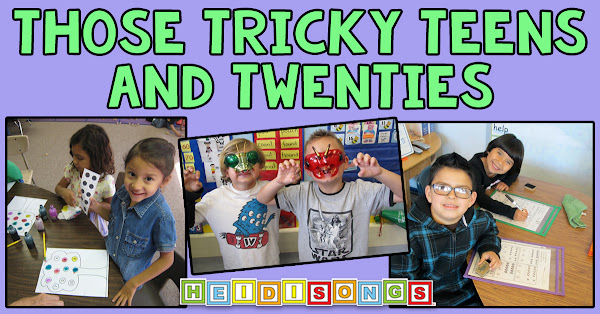
One thing that I did decide to do before I went was “freshen up” some of the activities for developing number concepts and learning to identify those tricky teens and twenties numerals in my Jumpin’ Numbers 0-30 presentation.  So, I searched my brain and blog archives and tried to pull all of my best ideas together into the one presentation, and then combine them into one handoutI am going to highlight a few of them here for you today, and then also give you a copy of the handout as a free download!  Please note that the handout includes activities for learning numbers from 0-30, but this blog entry is going to focus mainly on the teens. 


* Ten Frames and Counters
"Ten Frames" can help develop a sense of "ten-ness" at a glance.  Give the children one with a  completed ten and another one with a five to form 15.  Have the children look at the ten frames and try to put that many objects into a modified egg carton that has just ten spaces- five on each side, plus another five in a bowl or paper plate. Then have them find number 15 on a flashcard and match it, for example.   You can download ten frames free here on my website on the free downloads page.  Just scroll down about half way.  
Instead of the egg cartons, you can get the CounTEN Sorting Cartons.  Ice cube trays with ten spaces also work great.  Sometimes these can be found at the Dollar Store.  Change the objects with the seasons or the units of study, or change them with the holidays.  We use small sea animals, zoo animals, insects, Chirstmas counters, Valentine’s Day counters, cereal, pom-poms, etc.
Last year I blogged about several other similar types of activities that can be done with other seasonal recording sheets and matching manipulatives, including The Number Tree, (Vanessa Levin’s idea but with my downloadable tree), Pumpkin Patch Counting, and Spider Web Counting.  You can find the masters and write ups for each of these activities by following the links provided. 


*  Pattern Block Numbers and Rubber Stamps
Another fun activity is to print out the black and white version of the Number Pattern Blocks and have the children glue down some paper pattern blocks in the spaces to decorate them.  Then, have them try to stamp the correct number of objects above the numeral. This can be tricky though for the children who just LOVE to go crazy with the stamps and start stamping out as many impressions as they can and subsequently wind up with way too many.  I had them try for ten and circle them, and then add three more, for example, to get number 13.  If you can afford it, a better way to do this might be to use stickers, because they are more easily removed if the children lay down too many.  We just wound up having the children cross out the “extra” objects that they mistakenly stamped.  Number Pattern Blocks available for purchase at heidisongs.com; just follow this link and scroll down.  Also printed in black and white for gluing down the printable paper pattern blocks and then stamping the correct numbers at the top.


*  Matching Sets with the Teens and Twenties
Have children match the numbers to the sets by finding groups of ten and counting on from there.  I taught them to say, “TEN!  Eleven, twelve, thirteen....” etc.  I put some Place Value Practice Cards on a pocket chart and practiced counting on from 10 with the kids whole group for a minute or two each day after we did the calendar for a couple of weeks.  This REALLY helped a lot, and it makes sense that it would!  (For a free download of these cards, just follow the above link and scroll down.)  Research does support short, daily practice sessions to acquire a new skill.  It took about two weeks for most of the children to master it.  I simply asked them over and over, “How many are in a box?”  “How many are in a box?”  And the children would answer, “Ten!” every time. 


*  Stepping Stones Numbers
Combine motor development with math or language arts by writing numbers or words on “Stepping Stones” and have the kids step on them and identify the numbers as they go along.  These are really called “Rigid Dome Cones” and are sold on Amazon.  They also sell "Soft Dome Cones that collapse under the feet, but I haven't tried those.  With the rigid ones, you get 36 of them for $46.48.  My kids LOVED to do this during our motor development time in small groups out on the grass, or during our after school tutoring inside on the carpet.  A soft surface to play on IS important because they will fall off of them occasionally, although as you can tell by the little Facebook video of this activity I uploaded, the kids sure don't seem to care!


*  Transfering Number Skills to Paper
After that, I had them match these cards to the correct numerals in the teens or twenties either alone or in pairs. Once they had it, we tried to transfer it to paper.  Check out the free download of the Christmas Tree Match Sets Cards and the Match Sets Worksheets with the Clearboards for more activities to work on this transfer.


*  Singing the Number Songs as a Transitional Activity
Virtually every single day in my classroom, we sing songs as we are transitioning from one activity to another.  This helps get the blood moving through the body and sends oxygen to the brain to help prep the kids for their next lesson.  It also makes the room a happier place, and gives the children a reason and permission to move.  Did you know that happy children learn more?  It’s a fact!


*  Sing Along Songbooks for the Number Songs in a Listening Center 
You can incorporate literacy into your math lessons by making song books with the song lyrics.  You can buy them here, or you can type them up yourself by copying the words to the songs provided in the download of the handout.  This makes a nice listening center.  Some teachers have told me that they even use individual DVD players or laptops and show the DVD’s at their listening centers with headphones!  The children are to write the words or numbers as the songs play.


*  Write the Numbers While the DVD Plays
I try to find time for this activity, but we really wind up doing it more often with the sight word DVD's than for the Number DVD's.  So last year when I had a little girl who by February was still missing numbers 12 and 20, I sent home the Jumpin' Numbers Vol. 2 DVD with her.  I gave her the assignment to watch it each night for a week and write the numbers after each song.  I also noticed that her parents wrote the numbers on her binder and also pinned them to her backpack, so they were probably just looking for ways to ask her to identify the numbers several times a day, which is another great suggestion to give parents.  When her parents felt she knew the numbers, they sent it back.


*  Provide a Little Motivation 
Another year, a little boy's mom devised a reward system like this, and it really worked:  she bought him a special t-shirt he really wanted, and safety pinned the numbers to it.  She tacked the shirt to the wall in her hallway. Each time they walked by, she asked him the numbers.  When she felt he knew each number, she took it off the shirt.  When the shirt had no more numbers pinned to it, he got to wear it!   I have suggested this to parents who ask me for ideas to help their children learn at home. 

*  The Number Club:
Make a chart and put it on your wall.  As the children master all of the numbers from 0-30, (or whatever your goal is,) then let them write their name on that chart as a reward.  Children enjoy seeing their names up on charts like this!  We have had a Counting to 100 club, and a Letter Sounds club as well in past years.  I am including my Number Club master as a free download for you today!  To use it, all you have to do is mount it to the top half of a standard size piece of construction paper.  Then, as the children meet their goal, let them write their names on the bottom half of the construction paper chart, under the Number Club Master.  I laminated mine so that all I have to do is just tape it to a fresh piece of construction paper for the kids to write their names on when they reach the goal.


*  What if they are STILL not getting it?
Make your kids NEED the numbers and have to use them!
Line up by standing on words or numbers.
1.  Number your chairs and pencils, and have the children find certain ones that they must use each day when they sit down at your command.
2.  Number your carpet squares and/or line-up spots and have them go to certain ones.  If they need to know the numbers, they will learn them.
I saw this idea posted by a teacher on the Teachers.net Kindergarten Chatboard once a couple of years ago, and while I have never needed to go to such lengths, I always thought that it was clever and made perfect sense.

*  For More Great Ideas on Place Value in General:
Here's a link to a blog that is participating in a summer book study on Debbie Diller's Math Stations book.  I have only had a chance to take a quick glance, but it looks like it has some great ideas for further work on this topic at the first grade level and up!  The blog is called "Oceans of First Grade Fun" and it is written by Yolanda Adams.    Enjoy!

Friday, June 17, 2011

Pirate Day 2011 and More Favorite Quotes for Teachers!


Well, I have to say that summer vacation is SWEET! I finally got a chance to rest a little bit, after the rush of the last week of school. Also, I hate to admit it, but I AM getting older (ugh!), which of course beats the alternative. The great thing about having a birthday that usually comes at the beginning of summer vacation is that my husband and I usually treat ourselves to a couple of nights away as a birthday treat, and so today we went to San Diego! The other birthday treat that I am getting this year is an iPad, and I am really looking forward to figuring out how to use this new little device both in and out of the classroom! If anyone knows of any tricks or tips on using the iPad in the primary classroom, I would love it if you could pass them along to me. Just email them to info@heidisongs.com I’ll check them out. Thanks! Meanwhile, in honor of my birthday, I talked my wonderful husband Greg into giving us a free shipping code that will be good for this weekend ONLY! It is: BIRTHDAY.  It will expire on Sunday night, June 19th, at midnight, and it is good for shipping orders within the United States only. Sorry, we cannot honor it for international shipping orders.
Also, on Thursday night on my HeidiSongs Facebook page, I posted a set of comments that I had found on a Teachers.net chatboard under the heading of “Questions You Would Love to Ask Parents, But Can't.”   The comments that began to fill up the board ranged from absolutely hilarious to some that you may think really "crossed the line."   I highly recommend checking it out whenever you have the time and are in the mood for both a good laugh and some thought provoking reading material as well.  I would suspect that the comments that people have posted in June are much more "frank" than those that would be posted after our summer break.  I think that many of the comments are reflective of the frustration that so many teachers feel at being held accountable for the progress of students whom are only in are control for a fraction of the day and of their lives.  Where is the parental accountability, and even governmental accountability in all of this?


1. Pirate Day Was a BLAST! (And How to Make Those Treasure Chests)
We finally had our Pirate Day on our last day of school last week on June 10th, and I am posting some pictures from that day here. We had a wonderful time! We made the Pirate Hat that I posted the directions for a couple of weeks ago, played Buccaneer Bang for the first time, and dug for buried treasure, and played CVC Bingo for plastic gold coins! The children had a wonderful time, as you can see from the pictures.   If you would like to see a little video of the kids digging for their buried treasure, check out my HeidiSongs Facebook page.  It was hilarious!  They were supposed to be checking the map, but instead were ignoring the map and then digging in a spot where the sand had clearly been undisturbed for quite some time.  :)
Then we had a pizza party, and came in and they were able to redeem their gold coins for prizes, which were old Happy Meal toys, etc., and some used donated books that I couldn’t use. They also had the option of just keeping their gold coins, and they liked that, too.
Just in case you were wondering how we made the treasure chests, these are the directions:
Treasure Chests:
A. Cut off a clean and dry half gallon milk or juice type of carton four inches from the bottom and cover it with brown construction paper on the outside. We cut our construction paper 4” x 18” and glued it on with regular white glue. We also added some shiny silver sticker paper to two of the four sides that we did not intend to cover with popsicle sticks, but that is totally optional. I wouldn’t know where to tell you to get the sticker paper, anyway, since it was donated to us several years ago.
B. Ahead of time, have each child paint 20 popsicle sticks using bingo bottles filled with Liquid Water Color paint. (I purchased mine at Discount School Supply.) The children only need to paint one side of the sticks.
C. Have the children glue their sticks onto two sides of the box in any order they wish.
D. Glue some plastic jewels to the box if you like. Some of my children covered their boxes, and others chose to add none. It was interesting to see their choices! I let them choose this during their playtime. I had the jewels on hand from another project and they were again purchased from Discount School Supply.
If I could do this project again, I would definitely start collecting the milk cartons earlier. I had a big problem getting them from parents with just a week and half notice, because it seems that most people don’t buy milk or juice in the half gallon carton containers when their children are small. We wound up cutting off the tops of the cartons and folding in the lids and spouts so that we could use the tops of the cartons for more treasure chests. And we managed to accomplish all of this only with the help of a volunteer that took all of the remaining “tops” home with her for the evening to convert them into “bottoms” the night before we needed them. All of this could have been avoided if we had just started collecting the cartons much earlier. Actually, I should have known better, because the exact same thing happened last year, but my student teacher fixed it, so it wasn’t such a big deal! Oh well, maybe after two years I’ll learn from my own mistakes!

2. Work Has Begun on the Sounds Fun Workbooks!
Besides having a little bit of relax time, I also began creating the worksheets and the necessary illustrations that will go along with the Sounds Fun CD.  Unfortunately, due to the size, I think that it will wind up having to be split into two volumes, otherwise there will be too many pages to fit into the standard size workbook we usually print with about 140 pages. So our plan, for the time being, is to put the easiest digraphs, “chunks,” and phonics spelling patterns in the first volume, and then save the ones commonly taught last in most phonics programs for the second volume. But I would really like some feedback on what you all feel is the most logical order for each piece. So far, below you will find the order that I was considering putting them in, based on my knowledge of the phonics intervention programs that we use at my school, and the advice of a friend of mine that also teaches there.

The thing that puzzles me about this order is that I generally find the long vowels, especially the “Bossy E” and “Vowel Walk” words are very difficult for Kindergartners, but R controlled vowels are relatively easy for them to master. So I would have put those words before the long vowels, I think. My students also have very little trouble mastering the “oo” sound when taught with the Sounds Fun monkey card! They read those words like pros! The words with “oy” at the end and “ou” in the middle are usually pretty easy for them, too. Likewise, the words with “Ay” at the and “Ee” in the middle are also very easy. So now I REALLY don’t know what to do! If you have any opinions or advice on this, I would really appreciate it because if I were a teacher buying supplies, I would certainly rather buy just volume one if that’s all I needed, rather than both volumes, and I am trying to be sensitive to the needs of everyone. (This may be impossible, because I know from experience that you can’t please them all!) But anyway... please feel free to email me at info@heidisongs.com, or leave a comment on the blog. Thanks so much for your help!


Sounds Fun Workbook Volume One
1. Sh
2. Th
3. Ch
4. Unk
5. Ink
6. Ing
7. Ay
8. Ai
9. Ee
10. Ea
11. Oa
12. Bossy E
13. Vowel Walk (When two vowels go walking, the first one does the talking, etc.)
14. Oo (Book)
15. Oo (Boot)


Sounds Fun Workbook Volume Two
16. Ar
17. Or
18. Er
19. Ir
20. Ur
21. Oy
22. Oi
23. Ow
24. Ou
25. Magic Y (A “y” at the end of a word with two syllables or more makes a long E sound, as in “very.”)
26. Aw
27. Au
28. Ew
29. Igh

3. Quotes for Teachers, Set Two

I posted the first set of these inspirational "Quotes for Teachers" that I have been collecting a couple of weeks ago in a blog, with the promise of more to come.  Before my presentations, I have been playing a slide show of pictures of my students with these quotes along side of them, and a few of the participants have been suggesting that I include the quotes in my blog so that they could have copies of them.  So as requested, here they are!  Enjoy.  :)

"Never do for a child what the child can do for himself." Maria Montessori

"Failure is an essential part of the combination required to open the lock on success."
~Gary Ryan Blair

"The most successful people are those who are good at plan B."
~James Yorke

"Failure is only the opportunity to begin again more intelligently." ~Henry Ford

"Things that matter most must never be at the mercy of things that matter least."
~Goethe

Teach the way you feel works best for your kids. Make time for the things you KNOW work!
Sheri Sutterley

Teaching is mostly listening. Learning is mostly talking.
Debra Meier

"Tell your principal that if it is totally quiet in your room and the children are not moving, then it's likely that they are probably not learning much... or they're ill." Heidi Butkus

"You can learn many things from children. How much patience you have, for instance."
- Franklin P. Jones

"A great attitude is not the result of success; success is the result of a great attitude."
-Earl Nightingale

"If you must raise your voice, do it to cheer your students on."
~Author Unknown

If we did all the things we are capable of doing, we would literally astound ourselves.
~ Thomas Alva Edison

Friday, June 10, 2011

Our Last Day of School: FINALLY... and... The Wide Mouthed Frog Blog!

We finally had our last day of school this week on Thursday!  This has been the nicest group of children that I have had in a long time, and as ready as I am for a summer break, it is going to be hard to let them go and start over again in September!  It has been a while since I have been tempted to ask my administrators to loop from Kinder to first grade with a group of students, but this has definitely been one of those groups of kids that I could keep and go on with next year.  Anyway, the teachers at my school don’t generally loop with their students from Kinder to first, so it seems unlikely that this would ever happen.

1.  Our Wide Mouthed Frog Play - and Tips for Making Any Class Play Better 


We did our class play last week on June 2nd, the Wide Mouthed Frog, and it was a great success!  The children outdid themselves in “cuteness,” if I do say so myself!  And since it was my second time through putting on this particular play, I was able to fine tune a few things, and so I thought I might share some of these items with you here today, just in case any of you will be putting on the play yourselves in the future.
*  One thing that I had trouble with last year and this year while putting on this play was getting the children to sing along with the characters on the stage when it wasn’t their turn to be the “stars.”  I wanted them to be singing and doing the movements while seated, and what I was getting was not much more than a couple of children singing and the rest just watching the kids on the stage.  I was thinking that part of the problem could be that some of the motions for the songs really couldn’t be done very well while seated.  So I taught the children some other motions to do while seated when the baby froggies were doing the Hopping Along song.  Adding some “seated motions” and showing them how to do those movements while seated seemed to be the key to getting them to participate more while waiting for their turn to be featured on the stage.
*  Watch out for possible increases in class size when you are making your costumes the first year that you do the play.  Last year, I had a class of 24, but this year, I have 28.  This left me scrambling to find extra hats, shirts, tails, and sweatpants, etc., and it was incredibly stressful!  Luckily, last year I had anticipated some of this and purchased six of each of the elephant and monkey hats.  BUT... last year a nice grandmother made me the lion hats, and only made the five hats that I needed.  This year, when I went to make another, there were not even any extra supplies to make more of those hats in the box, and the fringe was a very unusual color.    This left one little boy with a totally different hat that he was not entirely comfortable with, and I felt bad about that.  So when you buy supplies for things like that, make sure that you buy some extra to have on hand just in case you wind up with more students than you planned on!  :(
*  I think my students would have done better if we had done a dress rehearsal in our costumes, and had a chance to try the play for a smaller audience first, such as just the rest of the Kindergarten classes.  We had our auditorium jam-packed and totally full of children and adults for our first performance, and some of the children resembled a deer in headlights!  But the second time they did it, they seemed much more relaxed and looked like they were having fun with it.  It made me wish that they had gotten rid of their stage fright before showing off all of our hard work to the rest of the school.  Plus, they were all so excited about being in their costumes that they were having a hard time concentrating.
*  Do a sound check before starting!  (Duh!)  I should know better, having sung at church and done dozens (or maybe hundreds) of sound checks in my life time.  Apparently, the people at the back of the auditorium couldn’t hear my narration very well.  But I was anxious to get started, and it sounded so LOUD from where I was sitting!  Just remember though, when the room is packed with people, they are going to absorb a lot of the sound, and then also make some sounds themselves (especially when most of those people are children).  So things like the narration have to be all the louder and clearer.
All in all, I would say that I just LOVE this play!   It is easy to put on- much easier than the Gingerbread Man or the Mitten, because there is less stage direction to give and therefore less to mess up.  The kids all seemed to feel special and enjoy their parts.  It always seems to work out well to have a bunch of well behaved little girls take the parts of the baby frogs, and have a very smart little girl play the Mother Frog.  I had one of my top students play the Mother Frog both this year and last, and both girls did it with no trouble whatsoever!  And there really is a LOT to remember in order to play that part!  The crocodile is always cute and steals the show.  And the songs are very EASY to learn.  This play is definitely my favorite of the three plays that I have written!  Love it!


2.  A Wide Mouthed Frog Puppet
We made a Wide Mouthed Frog Puppet on the day of our play, and it was really fun!  The children absolutely LOVED making their frogs sing and talk; they were SO excited!  I would definitely do it again!  I am sharing the pattern with you today as a free download.

3.  A Song for the Classroom “Motor Mouth!”
“Talking, talking, talking, way too much,
Way too much, way too much,
Talking, talking, talking, way too much,
It’s best to zip it up!”

After we put on this play, I found myself starting up this song spontaneously when kids were talking out of turn, and all of the kids would join in!  It’s just a snippet from the Finale of the play, but it works great as a reminder for the kids to just STOP talking!  And it’s kind of fun when everyone joins in on the reminder.  :)

4.  A Froggy Sight Word Game!
On the day of our play, I needed an extra activity for our special Froggy Themed rotation, so I decided to create a sight word game much like the ones that I made for Christmas, Thanksgiving, and in January with the Snowmen. I decided that we would play Memory with the words, and this actually didn’t work out very well because the words I printed on the frogs turned out to be too challenging for the bottom half the class, since I was trying to have them read some of the “ow” and “ou” spelling pattern words from our Sounds Fun cards, and we hadn’t had enough time to prepare for the game by working on the words.  I think that the problem was that they were using up most of their “brain power” on trying to decode those new words rather than remembering where the other matching word was in the Memory game.  So in the free download I am giving you today, I have changed the words to the sight words included on Sing and Spell Vol. 4

In any case, this is how you play the game:
 Mix up the cards and place them face UP on the table, keeping the fly card separate.  Have the children cover their eyes while you hide the fly card under one of the frog word cards.  The children must all chant, “Froggy, froggy!  My, oh, my!  Froggy, froggy, where’s that fly?”  Then a child attempts to read a word on one of the frog cards.  After identifying a word, then he or she may lift up that word to see if the fly is underneath it.  If it is, then that child is a winner and gets a piece of cereal or the treat of your choice.  If not, play continues until the fly is found.   
You may want to consider reducing the amount of cards that they have to choose from if the number seems a bit overwhelming.  And of course, I have included some blank cards at the end of the game for you so that you can change the words as you like
Have fun!

Friday, June 3, 2011

What Are They Doing While I’m Testing?

It’s been a really busy week, so this blog is going to be a quick one!  We had our Wide Mouthed Frog  play on Thursday night, and it went really well!  But I’ll be telling you more about that next week.  My report cards are due tomorrow, and I did manage to get the comments and scores all into the computer system yesterday afternoon!  Now I just have to get the behavior “scores” in by Friday before I leave for home, and I’ll be all set to finish the year!  It feels great to have it all be so close to done.  Our class will be going on a field trip to the Los Angeles Zoo on Wednesday, June 8th, and then Thursday, June 9th is our last day of school.  I can hardly believe it!
Meanwhile, I thought I would share some of the things that I have had my kids do this week while I was pulling them out individually to finish up their testing.  Of course, this wasn’t all of it, these were just some of the more novel, fun activities that they liked the best.  Enjoy!

1.  Monster Doodles 
When I was at the California Kindergarten Conference in January, one of the booths had a set of these “Monster Doodles" cards for sale,  and they caught my eye so I opened up the box to take a look.  I love to draw and doodle, and I know that kids usually do, too.  They also really love these types of friendly looking little monsters, so I figured it would be a winning combination!  So I snapped them up, even though the vendor was charging $15 for the set, and that seemed a little high to me.  (It was; they are just $9.99 on Amazon.)  My students have been loving them, though!
Monster Doodles is a set of 50 write-on, wipe-off cards that the children can doodle on.  They must read the directions in order to figure out what they are supposed to do to the card, though, and that is the only hard part.  Many of the children didn’t really care what the directions were; they just grabbed a dry erase marker and started drawing the features on the monsters, etc.  Others were really motivated to try to read the directions and kept at it until they figured it out. 
Some sample directions are:
- Draw horns on the monster
- Draw a face and claws on the monster
- Connect the dots to make a home for the monster
- Draw a friend for this monster.
Etc., etc., etc.  

The only bad thing about them is that some of the printing is in a rather small font, and they come with only one dry erase marker.  So if you want to use them with a group of kids, you would need some more fine point dry erase markers and erasers.  When I was checking to see if these were sold on Amazon, I noticed that the same authors also have a set called Animal Doodles and another called Christmas Doodles!  I ordered the Animal Doodles on right away.  They actually arrived yesterday!  I can’t wait to try these out now, too!

2.  Sight Word Splat 
When I was having my students use highlighters on some of the Sounds Fun worksheets that I made for my blog a couple of weeks ago,  (Please note that though I am going to develop some worksheets like these over the summer, they are not yet for sale.)  I discovered how fascinated my students are with highlighters in general!  I would not have guessed it, but it does make sense!  They are bright and pretty, and new!  So I decided to put a big sight word in the middle of a page and invite them to decorate it with highlighters while I was testing individually.
I showed them how to trace around and around the edges of the word and change colors often.  The ones that took their time with it really enjoyed it and came out with a beautifully decorated paper!  I am including this very simple master as a free download for you today.  Hopefully it will be useful for some of you.  I am including a couple with some words, and a blank frame, too, so that you can put your own word on it.  Just try to spread out the letters, if you can do so on your word processing program.  That way your kids will be able to go around the letters more easily.
I realized that I had purchased two packs of “Smelly Markers” last August when all of the school supplies went on sale, and I had tucked them away in a cupboard.  So I got those out too, and the children were of course enthralled!  Anything novel helps keep them happy at this time of year, doesn’t it?  It’s fun to listen to them sing the sight word songs while they color, too.  So cute!


3.  Outside Fun
My class really needed a break this week after practicing for our Wide Mouthed Frog play, so I decided to take them outside and let them play while I tested.  I figured that it would work alright as long as I only pulled the children that were more cooperative, etc.  I carried around some three dimensional shapes with me and said, “What is this?”  As they identified them, I just marked them off on my check off sheet.  If was a little unconventional, but I am confident in the results! 
And, every now and then, I pulled out my camera.  You can see the results in the wonderful pictures that I captured outside.  It sure feels good now and then to just go outside and enjoy the sunshine with the little ones!

4.  Watching Storybooks Online
About a month ago, I asked some Facebook friends if they knew of some great websites where I could find storybooks read aloud to children online, and I got a whole bunch of suggestions!  Since then, I have found it incredibly helpful to be able to put a story on our big screen and let the whole class watch it while I get materials out for a lesson, or put materials away, or even test a few children individually!  While the overwhelming favorite website suggested was http://www.tumblebooks.com/, that one does require a paid subscription, so I haven’t taken the plunge on purchasing it.  (But more on that below!)  My favorite website for this purpose so far is http://pbskids.org/lions/stories/.  Below here are a few more sites that I was given.  Please note that I haven’t had a chance to check them all out yet.  A few of them proved to take too long to load their books up (at least at my school) while the children waited, so watch out for that.  And some of them want you to sign up for an account, which can also be an annoying thing for kids to wait on, given the attention span of the average five year old!  I do recommend checking them out first!  But hey- we STILL haven’t made our way through all of the books just on the PBS website alone!

http://teacher.scholastic.com/clifford1/index.htm
http://www.storyplace.org/preschool/other.asp
http://www.meddybemps.com/5.1.html
http://www.goodnightstories.com/stories.htm
http://www.kizclub.com/reading1.htm
http://www.sundhagen.com/babbooks/
http://www.literactive.com/Home/index.asp
http://www.lil-fingers.com/storybooks/index.php
http://www.barnesandnoble.com/storytime/?cds2Pid=31442&linkid=1645204
http://www.wegivebooks.org/
http://www.magickeys.com/books/
http://www.zooburst.com/
http://storybird.com/accounts/login/

Subscription Required:
http://www.tumblebooks.com/
http://www.biguniverse.com/

BUT.... I happened upon this link (http://www.lancasterlibraries.org/lslc/cwp/view.asp?a=3&q=467512) , which was listed under “Tumblebooks Free” and I clicked on it.  It took me directly to the Tumblebooks site and allowed me to immediately start watching one of their books online, which was fully animated and beautiful!  One of my Facebook friends had mentioned that many public libraries have subscriptions to Tumblebooks, and if you have a library card, all you have to do is inquire about it and they will give you a login ID and password.  Sounds great!