This week, I only taught on Tuesday, since Monday was Presidents’ Day, and I had to fly out for to Oklahoma on Wednesday! I am scheduled to present at SDE’s Oklahoma Pre-K and Kindergarten Conference in Oklahoma City, so I wrote this blog entry early last weekend. Therefore, I decided to write about the answers to the top few questions that I seem to always get asked. Plus, I also threw in a section with some free downloads that I have been saving for a busy week just like this one! Hopefully, I’ll get to meet some really great people and pick up a few new ideas that I can pass along to you next week. Enjoy!
1. “Fishin’ for Addition” (And diamonds and hearts, too!)
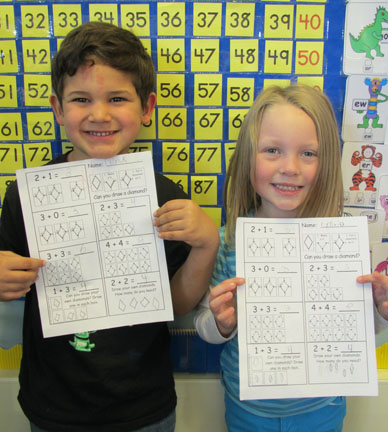
I made up these worksheets last month when I made the previous one with the stars on it that I gave away in January. I am giving you now the ones with the diamonds, hearts and fish on them, since they are very appropriate for this time of year! Find them here. Hopefully it is not too late for you to get some use out of them! I meant to give you the heart one a couple of weeks ago, but the blog got too full and then I forgot. Sorry! Drawing the fish is definitely tricky, so you may want to do the directed drawing activity from last week with the kids first.
Also, due to many requests, I have completed an entire set of Shark Teeth Addition worksheets that include sums from five to twelve, and they are now posted for sale on my website. If you were not following my blog in January, then check my entry on Friday, January 28, 2011 and see how much fun we had with the Shark Teeth Addition activity last month! There is a free download of one worksheet that I created there, plus the workmat. The download for purchase includes a worksheet for each set of sums up to the given number. For example, the first worksheet includes equations with sums up to five, and the second includes sums up to six, etc. Enjoy!
2. Top 3 Questions and Answers
A) Do you have any research to back up your materials? My principal insists that everything we use in the classroom must be research based.
Though we have not paid a big company to do a formal research project on my materials, I have done a bunch of research on it in my own classroom. If you look on my website, there is a tab across the top marked "Research." Or you can find it here.
It tells all of the research that I have done myself. There are also different people that I know of that have done research projects of their own using my materials for their Master's Theses. One of these teachers from northern California, Angelle Baladad, actually sent me a finished copy of her Master’s Thesis, and I am including it as a download here today, just in case anyone is interested in reading it or needs some more “ammunition” to help get their principal on the music and movement bandwagon!
Here is an excerpt from her research paper:
“The HeidiSongs sight word practice DVD was shown to the class 3 times per week for 4 weeks in 10 minute intervals. Students participated in movement activities accompanied by music to provide practice of reading and writing sight words. Informal observation during the instruction sessions indicated that my students were enjoying participating in HeidiSongs and students asked to do more when our sessions were over. Students indicated that they were beginning to feel successful.
Post-Test Data
After the intervention had been administered, it was time to reassess student learning. I administered the same one-on-one sight word assessment that was given as the pre-test. Student scores improved dramatically. Previous data showed that 14 students were unable to master this standard prior to the intervention. Post-test data indicated that 12 students out of 18 (66%) were now able to read the 13 district sight words fluently. Six students were still unsuccessful but attempted the assessment. This showed a growth of 44% on fluency overall. A post writing test was also given to measure student growth following the application of the intervention. This written test data revealed that 11 of the 18 students (61%) given the assessment were successful with using the sight words in their writing. This was an improvement of 60% from the pre-test.”
I also am going to including as a download today a list of related supporting book citations that support my methods. These were written by people like Robert Marzano, and they all are very supportive of brain friendly, multisensory methods such as mine. Below are some links to a few of my favorites from that list:
Birsh, Judith R. (2005) Multisensory Teaching of Basic Language Skills, Second Edition. Baltimore, MD: Brookes Publishing Company.
Hannaford, C. & Pert, C. (2005). Smart Moves: Why Learning Is Not All in Your Head. Stoddard, WI: Great River Books.
Jensen, E. (1998). Teaching with the Brain in Mind. Alexandria, VA: ASCD.
Marzano, R., Pickering, J. & Pollock, J. (2001). Classroom Instruction That Works: Research-Based Strategies for Increasing Student Achievement, Alexandria, VA: ASCD.
McIntosh, E. & Peck, M. (2005) Multisensory Strategies: Lessons and Classroom Management Techniques to Reach All Learners. New York, NY: Scholastic Inc.
B) What program do you use to make your worksheets and games?
I use Adobe Illustrator to make the pictures, and then I put the pictures into Quark Xpress to make the worksheets. (Bummer alert: Not only are they both rather expensive but hard to learn!) Last week’s Color By Nonsense word worksheet was done completely in Adobe Illustrator. I am blessed to have my husband around to show me how to use it; otherwise, I never would have been able to make it work. I would have needed to take a class, read a book on it, or at the very minimum do a tutorial several times! I am really only now starting to feel like I know how to use this application properly, and my husband knows the real truth here, which is that I am really a novice and not very good at it in comparison to the professionals that work in the “real world!”
Quark Xpress is a page layout/graphic design program that is also somewhat complicated, but well worth learning. It is MUCH more flexible than Microsoft Word! You can put your text anywhere on the page easily, without having it jump around as it constantly tries to “auto-correct” your work and move it back where MSWord thinks your text ought to be, how it should be punctuated, and then try to number your bullets. I use Word at school when I have to write there because that’s the only thing my district provides, but as far as I’m concerned, it absolutely pales in comparison to what you can do with Quark Xpress.
I use both programs on my Mac. They do make them for Windows operating systems, but I have not tried them on a PC. FYI: I'm very proficient on the Mac but unfortunately, comparatively lost on a PC! And that’s too bad, because I have no choice but to use a PC at school. Boooooo!
C) You teach full time, have a family, run your business and write this blog. How do you DO it?????
It seems to me that I get asked this question at least once a week! My standard response is this: “NOT by myself, that’s for sure!” Although I started off pretty much alone in my endeavors, my husband helped me enlist the help of my kids early on several years ago. All three of my daughters, who are now ages 21, 20, and 20 (twins!) have taken turns filling our orders. They had to learn how to help out around the house, and have always been expected to do that! But in any case, in the winter of 2009, I pretty much hit my limit of work. I just couldn’t take it anymore! I was getting up each morning no later than 5:00 AM (and sometimes earlier,) and answered all of the business related emails and faxes, and then returned phone messages. I also answered any morning phone calls before school. Then I arrived at school at 7:45 or so, and taught all day. If the phone rang during the day while I was teaching, I had to let it go to a message and then return these calls after school or on my break, or the next morning. I would get home at around 4:30 or 5:00 and check the rest of the emails and faxes, and try to solve customer service related problems. Somewhere in there, I managed to fix dinner most nights as well! I was usually at my computer handling more of the same until 8:00 or 8:30, and then I would pretty much collapse at 9:00 after about a bit of television with my family. And that’s without having to fill any orders at all, except for purchase orders, and I did all of those on the weekends. I was getting so stressed out that I was starting to snap at people, and even managed to get myself into trouble with my principal at work for being “too negative.” Trust me, this was NOT a good thing!
In any case, I was just about a stone’s throw away from a nervous break down, and I told my husband that one of us would just HAVE to quit our day job to run the business, or we would have to sell it, because I couldn’t go on like that anymore. And I really felt that if I left my teaching job, I would be miserable! I love teaching, and I do not want to quit. On the other hand, my husband Greg had a killer commute of about an hour and a half each way daily into Burbank for a very high pressure job in the creative department at Disney, and he was eager to try out working at home. So we made plans to arrange for that. Meanwhile, we got an accountant and a housekeeper to come each week. My husband was finally able to let go of his day job in May of 2010, and my life has improved SIGNIFICANTLY since then! He answers the phone, almost all of the emails and takes care of the customer service problems. He only sends me the emailed questions that he cannot answer himself. He works with our accountant and now also our illustrators and printers, and also handles all of the technical issues with the website and marketing. He really is doing just about everything around the house, too! He even cooks dinner for me nearly every night- AND does the laundry! He now fills all of the purchase orders himself, and my daughter Krissie, (one of the twins,) fills all of the internet and most of the phone orders. I feel incredibly blessed to have such an amazing support system in place! So could I EVER hope to do this by myself? No way!!!!
As far as the blog is concerned, I was not able to post regularly until my husband quit his job to stay home and run the business. But now, I do actually have SOME time to do this! So in the evenings, I usually sit on the couch and watch television with my computer in my lap. As I watch, I work on little resources that I might like to use in my classroom and also share with my blog readers. Then I write my blog around those resources, and also about what is working well in my classroom. Sometimes I get ideas from the emailed questions that people send me, too. When I write my response to the email, I save it and use it also in my blog. However, even though I write the blog, posting it so that you can access the downloads, and see the movies, etc. is all up to Greg! It usually takes him a minimum of two to three hours to post my blog.
It is still hard to find time to be creative and write music, but I usually wind up writing new songs while on vacation (I wrote all of the songs for Sing and Spell Vol. Five while on a cruise last winter!) It’s best to be out of the house and disconnected from the distraction of the internet so that I can give a new set of songs my full attention. I usually also need to have a good solid week off to create an entirely new presentation, including the Power Point and the handout. So, I usually must do these during the summer break or over Christmas vacation. By the way, many of the handouts I have created are available on my website to download free of charge any time you like. Help yourself!
Friday, February 25, 2011
Friday, February 18, 2011
Gone Fishin’ for Nonsense Words!
This week, my class braved a field trip to the Aquarium of the Pacific in Long Beach, CA in the rain, no less! If we are REALLY lucky, then we will get to do our great Jump Rope for Heart fundraiser today in the rain as well!!!! Oh, boy! Hey, if they have snow days back east, why can’t we have rain days in California? It just doesn’t seem FAIR! I have never had a day off for snow in my whole life! Boooo!
I am sharing with you today some guided drawing projects we have been working on over the past month, along with some other things for the February holidays and stuff I have been using for test review.
1. Learning to Sound Out CVC Words
Getting kids to sound out words is a tricky thing! There are a couple of “prerequisite skills” that each child must have in order to accomplish this.
* One thing they need is fluency in naming the letter sounds. In other words, they need to have really internalized the sounds of all of the letters, so that they can say them quickly and easily without really even thinking about it when they say them. I think that Zoo-Phonics really helps with this skill a lot, so check it out if you are unfamiliar! I wouldn’t consider teaching Kindergarten without it! And I’ll tell you something else: if my school district told me that I couldn’t use it anymore, I would just pull out the cards and supplement the given curriculum when no one was looking, because it really is the fastest, most efficient way that I know of to get kids to learn those all important letter sounds. I made my Singable Songs for Letters and Sounds CD and DVD to help with this as well, and it really has proven to be the missing link for children that cannot remember the letter sounds AND their names with any other method. It has worked for both regular and special education students alike. For more info on combining Zoo-Phonics with HeidiSongs, see my blog entry on April 18, 2009.
* Students also have to be able to hold at least three sounds in short term memory long enough to blend them into a word. This can be quite an overload for a child that is still unsure of the sounds, since that child must dedicate a good part of their available working memory to simply identifying each one. Therefore, a child that seems to have short term memory issues can be helped a little by having them “over learn” the letter sounds so that these (at least) are not something that is adding to the child’s memory overload. Other than that, I don’t really know of other ways to help a child learn to “stretch” their auditory memory other than practice: start with two sounds and then work your way up to three! If anyone out there knows of any other ways to help with this, please let me know and I will pass these tips along!
I must also say that my CVC book has been a great help to me every single year since I created it! I especially love the flashcards and the pictures, and the fact that you can use the larger cards on a pocket chart, and send a smaller version home with children to practice with at home. I use the worksheets every week in their homework and also sometimes at school. There are worksheets that go with them that are for sale on my website either in book form or as a download, along with those wonderful bingo games that the kids just LOVE! I know that I made it- and therefore I shouldn’t say it- but I cannot recommend this resource ENOUGH! I don’t know what I would do without it. And I am hoping to write a second volume with other word families in it someday, too! I’ll have to put that on my VERY long “to do” list!
2. Nonsense Words Vs. Real Words Coloring Sheet
Do You Have to Teach NONSENSE WORDS? Do you wonder WHY?????? Kids really do need to be able to blend random sounds together to form a word- even if it is a nonsense word! This is very important, since it forces the children to rely on their phonics skills to read accurately rather than just make informed guesses based on the context of the passage they are reading. Also, when they are older, they will need to be able to sound out each syllable or “chunk” of those longer multi-syllabic words that they will surely encounter as texts become more advanced. Without solid phonics skills, children may later find themselves unable to progress to reading texts with longer words, since these must be decoded (sounded out) instead of memorized.
To practice this sounding out both real and nonsense words, I like to use this small pocket chart that I got from ReallyGoodStuff.com.
I love this chart because you can simply keep pulling different letters in and out of the chart, either at the beginning, middle, or end of the word, since you can easily fit a bunch of cards in the pockets at once. The chart sits nicely in my lap as I sit in front of the class, or on a table to work with a small group. It’s called the Really Good Stuff® Word Blending Desktop Pocket Chart And Stand and it costs $19.99. I have used mine now for so many years, it’s just about worn out! When it falls apart, I will definitely buy another! BUT- for those of you that need to spend that money on your own living expenses, a teacher that I work with came up with a way to make her own out of a legal sized file folder. (Insert picture of the CVC Builder Chart.) If you look at the picture, you can see how she did it- mostly by stapling the folder into pockets and then adding the letter cards. It’s not as convenient and easy to hold, but it gets the job done!
Last weekend I decided to try to make a worksheet where the kids would color the pictures by real word or by nonsense word, and I decided to go with a patriotic theme since we are now learning about the presidents during February. We tried it on Thursday, and I was pleasantly surprised that most of them found it pretty easy! First I modeled the entire thing whole group and explained it thoroughly. Then I sat with them while they did it during their small group rotation and stopped the children from coloring one by one and listened to them read the words to me individually, asking them if each word was a real or nonsense word. This turned out to be a wonderful way of keeping everyone happy and busy while I listened to each of them read one at a time! I am including the master for you here today! I hope you enjoy using it with your students.
3. Lincoln Log Cabin Art Project
This is one simple little art project idea that I got from a teacher that I used to work with who recently retired. I have no idea where she got the idea from! In this project, the children glue down popsicle sticks in a rectangle that is xeroxed onto the paper ahead of time. Then they add a triangle roof and a door, and then decorate their paper so that it looks like the wilderness surrounding that famous log cabin. I am including the master that I made and instructions as a free download for you today! I hope that it will be useful to you. You may also be interested in looking at this website for some other great art projects about the presidents: http://www.tlclessons.com/about.php. The author of the books, Kay Espinoza, has also posted a free download of a Barak Obama project, so you might want to check that one out, too!
4. Sea Life Directed Drawing
This week, we finished our Look Out! Book on sea animals from the Little Songs for Language Arts Singable Books Printable Projects Resource CD, that culminated our unit with a trip to the Aquarium of the Pacific in Long Beach, CA! I have been teaching the children to draw sea animals over the past month, and have been snapping some pictures of their drawings along the way. It’s such a fun activity, and I love that I see their drawings pop up in their writing assignments and when they decide to draw during playtime, etc.! I wrote up the directions for a few of the animals for you and including them here for you today. Please note that we sure did NOT draw ALL of these animals on the same day! I think we drew together at least twice. Sometimes when I want to draw with the children and we don’t have a lot of time, I just pass out the white boards instead of the paper. This allows the children to make lots of mistakes and keep trying as much as they like. I think they find it less frustrating when an animal kind of needs “multiple attempts.” Even though I always tell them that we are just practicing and that mistakes don’t matter, a lot of those kids just don’t want imperfections on their papers and can really stress out over it.
Every year, there seems to be one child that will find their mistakes so frustrating that they wind up in tears nearly every time we draw! If I can, I put that child with a parent volunteer if one is available, or right next to me on the floor. If the child is getting frustrated, I just grab a pencil and lightly sketch in the part that is stressing the child out, which is usually just a diagonal line or two! Then the child can happily proceed by tracing over my line with his or her black marker. Enjoy!
I am sharing with you today some guided drawing projects we have been working on over the past month, along with some other things for the February holidays and stuff I have been using for test review.
1. Learning to Sound Out CVC Words
Getting kids to sound out words is a tricky thing! There are a couple of “prerequisite skills” that each child must have in order to accomplish this.
* One thing they need is fluency in naming the letter sounds. In other words, they need to have really internalized the sounds of all of the letters, so that they can say them quickly and easily without really even thinking about it when they say them. I think that Zoo-Phonics really helps with this skill a lot, so check it out if you are unfamiliar! I wouldn’t consider teaching Kindergarten without it! And I’ll tell you something else: if my school district told me that I couldn’t use it anymore, I would just pull out the cards and supplement the given curriculum when no one was looking, because it really is the fastest, most efficient way that I know of to get kids to learn those all important letter sounds. I made my Singable Songs for Letters and Sounds CD and DVD to help with this as well, and it really has proven to be the missing link for children that cannot remember the letter sounds AND their names with any other method. It has worked for both regular and special education students alike. For more info on combining Zoo-Phonics with HeidiSongs, see my blog entry on April 18, 2009.
* Students also have to be able to hold at least three sounds in short term memory long enough to blend them into a word. This can be quite an overload for a child that is still unsure of the sounds, since that child must dedicate a good part of their available working memory to simply identifying each one. Therefore, a child that seems to have short term memory issues can be helped a little by having them “over learn” the letter sounds so that these (at least) are not something that is adding to the child’s memory overload. Other than that, I don’t really know of other ways to help a child learn to “stretch” their auditory memory other than practice: start with two sounds and then work your way up to three! If anyone out there knows of any other ways to help with this, please let me know and I will pass these tips along!
I must also say that my CVC book has been a great help to me every single year since I created it! I especially love the flashcards and the pictures, and the fact that you can use the larger cards on a pocket chart, and send a smaller version home with children to practice with at home. I use the worksheets every week in their homework and also sometimes at school. There are worksheets that go with them that are for sale on my website either in book form or as a download, along with those wonderful bingo games that the kids just LOVE! I know that I made it- and therefore I shouldn’t say it- but I cannot recommend this resource ENOUGH! I don’t know what I would do without it. And I am hoping to write a second volume with other word families in it someday, too! I’ll have to put that on my VERY long “to do” list!
2. Nonsense Words Vs. Real Words Coloring Sheet
Do You Have to Teach NONSENSE WORDS? Do you wonder WHY?????? Kids really do need to be able to blend random sounds together to form a word- even if it is a nonsense word! This is very important, since it forces the children to rely on their phonics skills to read accurately rather than just make informed guesses based on the context of the passage they are reading. Also, when they are older, they will need to be able to sound out each syllable or “chunk” of those longer multi-syllabic words that they will surely encounter as texts become more advanced. Without solid phonics skills, children may later find themselves unable to progress to reading texts with longer words, since these must be decoded (sounded out) instead of memorized.
To practice this sounding out both real and nonsense words, I like to use this small pocket chart that I got from ReallyGoodStuff.com.
I love this chart because you can simply keep pulling different letters in and out of the chart, either at the beginning, middle, or end of the word, since you can easily fit a bunch of cards in the pockets at once. The chart sits nicely in my lap as I sit in front of the class, or on a table to work with a small group. It’s called the Really Good Stuff® Word Blending Desktop Pocket Chart And Stand and it costs $19.99. I have used mine now for so many years, it’s just about worn out! When it falls apart, I will definitely buy another! BUT- for those of you that need to spend that money on your own living expenses, a teacher that I work with came up with a way to make her own out of a legal sized file folder. (Insert picture of the CVC Builder Chart.) If you look at the picture, you can see how she did it- mostly by stapling the folder into pockets and then adding the letter cards. It’s not as convenient and easy to hold, but it gets the job done!
Last weekend I decided to try to make a worksheet where the kids would color the pictures by real word or by nonsense word, and I decided to go with a patriotic theme since we are now learning about the presidents during February. We tried it on Thursday, and I was pleasantly surprised that most of them found it pretty easy! First I modeled the entire thing whole group and explained it thoroughly. Then I sat with them while they did it during their small group rotation and stopped the children from coloring one by one and listened to them read the words to me individually, asking them if each word was a real or nonsense word. This turned out to be a wonderful way of keeping everyone happy and busy while I listened to each of them read one at a time! I am including the master for you here today! I hope you enjoy using it with your students.
3. Lincoln Log Cabin Art Project
This is one simple little art project idea that I got from a teacher that I used to work with who recently retired. I have no idea where she got the idea from! In this project, the children glue down popsicle sticks in a rectangle that is xeroxed onto the paper ahead of time. Then they add a triangle roof and a door, and then decorate their paper so that it looks like the wilderness surrounding that famous log cabin. I am including the master that I made and instructions as a free download for you today! I hope that it will be useful to you. You may also be interested in looking at this website for some other great art projects about the presidents: http://www.tlclessons.com/about.php. The author of the books, Kay Espinoza, has also posted a free download of a Barak Obama project, so you might want to check that one out, too!
4. Sea Life Directed Drawing
This week, we finished our Look Out! Book on sea animals from the Little Songs for Language Arts Singable Books Printable Projects Resource CD, that culminated our unit with a trip to the Aquarium of the Pacific in Long Beach, CA! I have been teaching the children to draw sea animals over the past month, and have been snapping some pictures of their drawings along the way. It’s such a fun activity, and I love that I see their drawings pop up in their writing assignments and when they decide to draw during playtime, etc.! I wrote up the directions for a few of the animals for you and including them here for you today. Please note that we sure did NOT draw ALL of these animals on the same day! I think we drew together at least twice. Sometimes when I want to draw with the children and we don’t have a lot of time, I just pass out the white boards instead of the paper. This allows the children to make lots of mistakes and keep trying as much as they like. I think they find it less frustrating when an animal kind of needs “multiple attempts.” Even though I always tell them that we are just practicing and that mistakes don’t matter, a lot of those kids just don’t want imperfections on their papers and can really stress out over it.
Every year, there seems to be one child that will find their mistakes so frustrating that they wind up in tears nearly every time we draw! If I can, I put that child with a parent volunteer if one is available, or right next to me on the floor. If the child is getting frustrated, I just grab a pencil and lightly sketch in the part that is stressing the child out, which is usually just a diagonal line or two! Then the child can happily proceed by tracing over my line with his or her black marker. Enjoy!
Friday, February 11, 2011
Week 22: Presidential Holidays, and the Testing Two-Step
Well, in and amongst all of the February celebrations, we somehow have to find time to get all of our testing done, since our upcoming reporting period will be ending soon. So I find myself trying to figure out ways to keep groups of children occupied so that I can steal a few moments “alone” with each one for testing. My goal is always to get it done early enough so that I can help the few kids that are “straggling” along on a few concepts. That way, I can help them a little bit more and then retest the children again at the very last minute if I think they may have mastered some of the concepts.
Besides all of the regular holidays, we also have a field trip to the Aquarium of the Pacific in Long Beach, CA next week on Wednesday, plus our school’s annual Jump Rope For Heart fund raiser for the American Heart Association on Friday. So I am trying to take advantage of every teachable and testable moment that we have, because of course before I know it, February will be GONE!
As far as I am concerned, there is nothing worse than spending all your time in the classroom testing and then doing nothing educational with the results of those tests. So I keep reminding myself of this fact: the purpose of administering these tests is NOT so that I can fill out a report card. It is so I can deliver better instruction and better meet the children's needs. When I know exactly which sight words they know, which CVC word families they need help with, and which phonemic awareness concepts they have mastered and which they need to work on, then I can teach all the more efficiently. Of course, this is based on the assumption that I am allowed to make my own lesson plans based on what my children have mastered and what they need to work on, rather than what the teacher manual’s script says to do. But that’s a different issue, so let’s not go there!
1. Getting Testing Done Efficiently - and Making it MATTER
Here are a couple of things I do to help get testing done quickly and making the most of my time:
* Get the testing supplies out the night before. Make a list of kids that need to take that test. I have a small desk set aside with all of the testing supplies on it and I leave it set and ready so that I can immediately test whenever there is a spare moment.
* I keep a check off list of kids names and write their scores in pencil next to their names. That way I can easily see who still needs to be tested and what the scores are. I can also note the trends that are appearing, too. For example, when I tested on Concepts of Print, I wrote each test question across the top of the check off sheet. Then I put a check mark each time a child answered correctly, but a dot if the child was asked but answered incorrectly. So as I look at my chart, I can quickly see which concepts were internalized well and which were not. So, now I know what I should review with the whole class, and what I should review with certain groups, etc. As I continue teaching and it seems that certain children have mastered a skill, I pull them and test them again.
* I try to keep a few extra “fun and easy” coloring types of worksheets that the kids can do alone on hand during the testing season, just in case I need to give the class something while I test some children individually. I don’t do this very often, but when I have to, I will.
* If there is a very “mechanical” test that can be done by a volunteer, then I will let a reliable volunteer do it. Tasks such as listening to the kids count to 100, count objects, sort, or identify shapes are good examples of tests that I generally feel comfortable letting a reliable volunteer administer. These tests work well being given by volunteers because the answers are solid and objective; there is no guess work involved in deciding whether or not the child got the answer right.
* If I can get to it, I send home lists of words or skills that children need to work on about a month or so before the reporting period ends. At that time of year, parents are usually well motivated to help their children improve so that they can get a better report card. If they get this list after the report card is given, I believe that much of the urgency is gone, since they know that they have several more months to help their child before the next report card is due.
* I create practice tests that looks just like the real thing whenever I can. Very often, it’s the format of the test that messes the kids up. So once I think my students have mastered a concept, I teach them how to do a worksheet that looks like their test. That way, when they see the test for the first time, they don’t “freeze up” and forget everything just because it is a brand new format. I am including a couple of my practice tests for you here as free downloads; they are for writing the alphabet and writing the numbers 0-30. The second page on each one has an example of a correctly done paper that you can send home with kids so that parents will know what you are looking for in terms of “correct.” I hope they are useful to you!
* Whenever I am done with a test, I always ask myself: what did they learn well, and why? What did the kids not learn well, and why? What did I do wrong? Anytime a more than 10-15% of the class misses a single concept, I go on the assumption that I didn’t teach that concept well enough, and I need to think of a better way to do it and try again. And in my opinion, this is one reason why scripted texts can’t possibly work as well as a teacher with a brain in her head and some solid reasoning skills can. You have to be able to figure out what is working (or not working) with certain children, and then have the freedom to try to teach it in another way so that you can reach all of the learners in your class. If you have to follow a script while you teach, you can kiss that possibility good-bye.
2. Fun Concept Review: Power Point Presentations with your STUDENTS in them!
Speaking of helping the kids catch up on any missed concepts, I started a new thing this week that I mentioned on my HeidiSongs Facebook page , and it is working out so well that I wanted to mention it here. I decided that we needed to drill a bit more on the sight words, but I wanted to be able to do it whole group in a fun and engaging way. So I thought of taking pictures of each child holding a large sign with a sight word printed on it, and then putting this picture into a Power Point presentation. Then I drilled the entire class on the words using that presentation! We have had a ball this week looking at the pictures and reading the words. I highly recommend it!
Of course, only AFTER I went to all of the trouble of writing up the words on full sized pieces of construction paper and taking pictures of all of my students, I realized that I could have used any existing pictures that I had of my students and added a large text box with the word in it! And the words and text could have been in any font, in any color! I realized this because one of my students was out sick the entire week while I was trying to take the photos, but I didn’t want her to be left out even for a day, so I just went through my other pictures in iphoto and picked a couple of cute ones and added a text box. Because these pictures were especially cute and different than the rest, they got a HUGE reaction from the kids! Luckily, the child in the photo also laughed right along with the other children and was not upset about it. But I did ask her if she would rather have a “regular” picture of herself holding the word like everyone else, or if she would prefer to have me leave it, and she expressed her desire for me to change it to be like everyone else’s. I got that accomplished by Thursday, (yay!) but each day as we watched the first version of it, I was reminded of a valuable lesson I once learned: the brain loves novelty, and my students have brains!
They LOVED the different pictures of their classmate, and the next time I make one of these drill and practice presentations, I am going to try and insert some really cute existing pictures of the kids doing things they have done throughout the year, or at least pose them in different places around the room. Then I can superimpose the word or number, etc., somewhere in front of the picture where it won’t hide too much of it. I’ll let you know how it works!
I also learned to move the hardest “look alike” words, such as “with” and “white” to slides that are right next to each other. That way, I can show the slide and then the next, and then back up to drill on those couple of words many times and play the “I’m going to see if I can fool you!” game with them. I am also planning on changing the words around that they are holding so that the children that have the hardest time paying attention are holding the words that are the most difficult to learn. I can't wait to see how that works!!!!
3. A Creative Flag Art Project
One thing that I really enjoy doing with my class in February is having them design their own red, white, and blue flag with their third grade book buddies. I give them a full sheet of 12 x 18 white construction paper, plus red and blue pieces of paper in a variety of sizes and shapes. I also give them some stars xeroxed onto red, white, and blue paper, star shaped confetti, crazy scissors, hole punchers. The children also painted some red and blue designs on white paper with some interesting scrapers and rollers that I purchased at an educational supply store. So we cut up some of this paper as well for them to use on their flags. I encourage the children to make some three dimensional effects on their flags, such as curled or accordion folded paper. Here are some pictures of my samples.
We are making our flags on Friday next week with our book buddies, so I will post some pictures of the children’s work soon. But I wanted to pass along the idea with plenty of time for you to use it if you like, and I am including the master with the stars as a free download for you here. Enjoy!
4. The Sound Deletion Bingo Game REALLY WORKS!
Here is a game that I developed that is designed to help kids practice the skill of sound deletion. (Sound deletion is a phonemic awareness skill commonly taught in both kindergarten and first grade, and is on the famous DIBELS test.) In this game, the children listen to the bingo caller say a word and are asked to say it back without the beginning sound. Then they find the word on their bingo board without that beginning sound. For example, the bingo caller might say, "What's 'sit' without /ssss/?" Then the child would find the word "it." Therefore, the children must use both their phonemic awareness and reading skills to play. The first person to cover all of the spaces on their board is the winner.
Over the past month, I have had a really wonderful parent volunteer play this game a couple of times with the groups of children that have seemed ready for it. Other than that, I BARELY covered this difficult phonemic awareness skill at all. Boy, was I surprised when after pulling the kids for testing, about 75% of the class actually passed this test! One of my students was able to get eight out of ten of the sound deletion questions correct, but passed almost NONE of the other phonemic awareness skills that were supposed to be prerequisite skills that come before sound deletion! I don’t really understand how he could have picked up this skill without developing any of the other skills that usually come first, but I guess this is the power of the motivational game. That child LOVES bingo! And in order to play the game, he had to figure out how to do sound deletion. I suppose this means that I really should create other phonemic awareness bingo games, right? In any case, the Sound Deletion Bingo Game is now posted for sale as a download on the game page of our website. Check it out!
5. We love the Counting to 100 song!
Is there a better time to sing the counting to 100 song than on the 100th day of school? We certainly enjoyed it! I hope you enjoy this video clip of my students singing the counting to 100 song on the 100th day of school, while wearing their Hundredth Day Hats! This song is on both the Jumpin’ Numbers and Shakin’ Shapes CD/DVD, and the Musical Math CD/DVD. :
Besides all of the regular holidays, we also have a field trip to the Aquarium of the Pacific in Long Beach, CA next week on Wednesday, plus our school’s annual Jump Rope For Heart fund raiser for the American Heart Association on Friday. So I am trying to take advantage of every teachable and testable moment that we have, because of course before I know it, February will be GONE!
As far as I am concerned, there is nothing worse than spending all your time in the classroom testing and then doing nothing educational with the results of those tests. So I keep reminding myself of this fact: the purpose of administering these tests is NOT so that I can fill out a report card. It is so I can deliver better instruction and better meet the children's needs. When I know exactly which sight words they know, which CVC word families they need help with, and which phonemic awareness concepts they have mastered and which they need to work on, then I can teach all the more efficiently. Of course, this is based on the assumption that I am allowed to make my own lesson plans based on what my children have mastered and what they need to work on, rather than what the teacher manual’s script says to do. But that’s a different issue, so let’s not go there!
1. Getting Testing Done Efficiently - and Making it MATTER
Here are a couple of things I do to help get testing done quickly and making the most of my time:
* Get the testing supplies out the night before. Make a list of kids that need to take that test. I have a small desk set aside with all of the testing supplies on it and I leave it set and ready so that I can immediately test whenever there is a spare moment.
* I keep a check off list of kids names and write their scores in pencil next to their names. That way I can easily see who still needs to be tested and what the scores are. I can also note the trends that are appearing, too. For example, when I tested on Concepts of Print, I wrote each test question across the top of the check off sheet. Then I put a check mark each time a child answered correctly, but a dot if the child was asked but answered incorrectly. So as I look at my chart, I can quickly see which concepts were internalized well and which were not. So, now I know what I should review with the whole class, and what I should review with certain groups, etc. As I continue teaching and it seems that certain children have mastered a skill, I pull them and test them again.
* I try to keep a few extra “fun and easy” coloring types of worksheets that the kids can do alone on hand during the testing season, just in case I need to give the class something while I test some children individually. I don’t do this very often, but when I have to, I will.
* If there is a very “mechanical” test that can be done by a volunteer, then I will let a reliable volunteer do it. Tasks such as listening to the kids count to 100, count objects, sort, or identify shapes are good examples of tests that I generally feel comfortable letting a reliable volunteer administer. These tests work well being given by volunteers because the answers are solid and objective; there is no guess work involved in deciding whether or not the child got the answer right.
* If I can get to it, I send home lists of words or skills that children need to work on about a month or so before the reporting period ends. At that time of year, parents are usually well motivated to help their children improve so that they can get a better report card. If they get this list after the report card is given, I believe that much of the urgency is gone, since they know that they have several more months to help their child before the next report card is due.
* I create practice tests that looks just like the real thing whenever I can. Very often, it’s the format of the test that messes the kids up. So once I think my students have mastered a concept, I teach them how to do a worksheet that looks like their test. That way, when they see the test for the first time, they don’t “freeze up” and forget everything just because it is a brand new format. I am including a couple of my practice tests for you here as free downloads; they are for writing the alphabet and writing the numbers 0-30. The second page on each one has an example of a correctly done paper that you can send home with kids so that parents will know what you are looking for in terms of “correct.” I hope they are useful to you!
* Whenever I am done with a test, I always ask myself: what did they learn well, and why? What did the kids not learn well, and why? What did I do wrong? Anytime a more than 10-15% of the class misses a single concept, I go on the assumption that I didn’t teach that concept well enough, and I need to think of a better way to do it and try again. And in my opinion, this is one reason why scripted texts can’t possibly work as well as a teacher with a brain in her head and some solid reasoning skills can. You have to be able to figure out what is working (or not working) with certain children, and then have the freedom to try to teach it in another way so that you can reach all of the learners in your class. If you have to follow a script while you teach, you can kiss that possibility good-bye.
2. Fun Concept Review: Power Point Presentations with your STUDENTS in them!
Speaking of helping the kids catch up on any missed concepts, I started a new thing this week that I mentioned on my HeidiSongs Facebook page , and it is working out so well that I wanted to mention it here. I decided that we needed to drill a bit more on the sight words, but I wanted to be able to do it whole group in a fun and engaging way. So I thought of taking pictures of each child holding a large sign with a sight word printed on it, and then putting this picture into a Power Point presentation. Then I drilled the entire class on the words using that presentation! We have had a ball this week looking at the pictures and reading the words. I highly recommend it!
Of course, only AFTER I went to all of the trouble of writing up the words on full sized pieces of construction paper and taking pictures of all of my students, I realized that I could have used any existing pictures that I had of my students and added a large text box with the word in it! And the words and text could have been in any font, in any color! I realized this because one of my students was out sick the entire week while I was trying to take the photos, but I didn’t want her to be left out even for a day, so I just went through my other pictures in iphoto and picked a couple of cute ones and added a text box. Because these pictures were especially cute and different than the rest, they got a HUGE reaction from the kids! Luckily, the child in the photo also laughed right along with the other children and was not upset about it. But I did ask her if she would rather have a “regular” picture of herself holding the word like everyone else, or if she would prefer to have me leave it, and she expressed her desire for me to change it to be like everyone else’s. I got that accomplished by Thursday, (yay!) but each day as we watched the first version of it, I was reminded of a valuable lesson I once learned: the brain loves novelty, and my students have brains!
They LOVED the different pictures of their classmate, and the next time I make one of these drill and practice presentations, I am going to try and insert some really cute existing pictures of the kids doing things they have done throughout the year, or at least pose them in different places around the room. Then I can superimpose the word or number, etc., somewhere in front of the picture where it won’t hide too much of it. I’ll let you know how it works!
I also learned to move the hardest “look alike” words, such as “with” and “white” to slides that are right next to each other. That way, I can show the slide and then the next, and then back up to drill on those couple of words many times and play the “I’m going to see if I can fool you!” game with them. I am also planning on changing the words around that they are holding so that the children that have the hardest time paying attention are holding the words that are the most difficult to learn. I can't wait to see how that works!!!!
3. A Creative Flag Art Project
One thing that I really enjoy doing with my class in February is having them design their own red, white, and blue flag with their third grade book buddies. I give them a full sheet of 12 x 18 white construction paper, plus red and blue pieces of paper in a variety of sizes and shapes. I also give them some stars xeroxed onto red, white, and blue paper, star shaped confetti, crazy scissors, hole punchers. The children also painted some red and blue designs on white paper with some interesting scrapers and rollers that I purchased at an educational supply store. So we cut up some of this paper as well for them to use on their flags. I encourage the children to make some three dimensional effects on their flags, such as curled or accordion folded paper. Here are some pictures of my samples.
We are making our flags on Friday next week with our book buddies, so I will post some pictures of the children’s work soon. But I wanted to pass along the idea with plenty of time for you to use it if you like, and I am including the master with the stars as a free download for you here. Enjoy!
4. The Sound Deletion Bingo Game REALLY WORKS!
Here is a game that I developed that is designed to help kids practice the skill of sound deletion. (Sound deletion is a phonemic awareness skill commonly taught in both kindergarten and first grade, and is on the famous DIBELS test.) In this game, the children listen to the bingo caller say a word and are asked to say it back without the beginning sound. Then they find the word on their bingo board without that beginning sound. For example, the bingo caller might say, "What's 'sit' without /ssss/?" Then the child would find the word "it." Therefore, the children must use both their phonemic awareness and reading skills to play. The first person to cover all of the spaces on their board is the winner.
Over the past month, I have had a really wonderful parent volunteer play this game a couple of times with the groups of children that have seemed ready for it. Other than that, I BARELY covered this difficult phonemic awareness skill at all. Boy, was I surprised when after pulling the kids for testing, about 75% of the class actually passed this test! One of my students was able to get eight out of ten of the sound deletion questions correct, but passed almost NONE of the other phonemic awareness skills that were supposed to be prerequisite skills that come before sound deletion! I don’t really understand how he could have picked up this skill without developing any of the other skills that usually come first, but I guess this is the power of the motivational game. That child LOVES bingo! And in order to play the game, he had to figure out how to do sound deletion. I suppose this means that I really should create other phonemic awareness bingo games, right? In any case, the Sound Deletion Bingo Game is now posted for sale as a download on the game page of our website. Check it out!
5. We love the Counting to 100 song!
Is there a better time to sing the counting to 100 song than on the 100th day of school? We certainly enjoyed it! I hope you enjoy this video clip of my students singing the counting to 100 song on the 100th day of school, while wearing their Hundredth Day Hats! This song is on both the Jumpin’ Numbers and Shakin’ Shapes CD/DVD, and the Musical Math CD/DVD. :
Friday, February 4, 2011
Week 21: Love is in the Air in February
Well, it just may be that Valentine’s Day is the most wonderful, most loving, most pure of all of the classroom celebrations that take place in Kindergarten! The children are genuinely excited about giving their cards and gifts to each other, no matter how small. And the only children who will be truly disappointed on that special day are the ones who do not bring anything to give to their friends. It’s not that they do not receive anything, because they will. Those children who do not bring any Valentines Day cards are sure to be very unhappy because they have nothing to give- no cards to deliver, and no goodies to give away.
Maybe this is why teachers seem to be so drawn to February projects that feature hearts as a motif, and I am certainly no exception! I hope that you will enjoy this blog entry and the fun Valentine’s Day themed activities that I have to share with you this week.
As far as my “HeidiSongs Life” is concerned, I will be traveling to Oklahoma City very soon, for the SDE Oklahoma Pre-K and Kindergarten Teachers Conference. If any of you live nearby, I would love to meet you there! So if you can get a day off to attend a fun conference that is directed specifically at YOUR grade level, that is the place to be! I just hope that the weather allows me to travel as planned!
1. Sweet Sight Word Surprise and Color By Sight Word Worksheet
In my blog entry on September 24, 2010 (http://heidisongs.blogspot.com/2010/09/whats-working-week-five.html) I posted an idea for something I called the “Secret Sight Word Surprise.” In this activity, you prepare the papers ahead of time by writing some different sight words on them with a white crayon. Then the children water color the paper, and as they do, the word becomes visible, since it is essentially a water color resist! Although my children have by now discovered the secret of how it works, I thought that they would enjoy another one, and we do need to work on identifying certain sight words that look similar, such as “they,” “that,” “this,” and “with.” So I made another one of these for you with a Valentine’s Day theme, and decided to call it the “Sweet Sight Word Surprise.” I have also discovered that the Roseart brand white crayons don’t show up as much on the white paper as the Crayola brand crayons do, so the Roseart crayons are better for writing the words on the paper ahead of time since that way the kids really can’t see the word until they start painting. The Crayola brand crayons are such a high quality that the white definitely shows up on the white paper. The high quality crayons are great- just not for this particular activity!
To get a little more mileage out of this master for the Sweet Sight Word Surprise, I decided to also turn it into a Color by Sight Word worksheet, and I have included this as a free download for you as well today! I hope that you enjoy using it.
You may also wish to take a look at another idea that I posted on my HeidiSongs Facebook page this week. We did some magnetic marble painting on some heart stencils that I punched out with the Ellison Die Cut machine that we have at school. The children LOVED this activity, and it is really different marble painting with magnetic marbles rather than regular marbles because the kids can control where the marble is going. I even posted a little video clip of one little girl as she paints. It’s pretty fascinating to watch the marble dance around; the paint really splatters in a different sort of way than it does when the marble is merely rolling around using gravity.
2. This Is What Happens When Your Students Have the DVD’s at Home (AKA: This is How You Can Get Free Stuff from HeidiSongs!)
I am blessed enough to be able to give each of my students a DVD to use at home at the beginning of the year. I know that this situation is unique to me, but the reason I am telling you this is so that you may not know what can happen when children have access to the CD’s or DVD’s at home.
At the beginning of the school year, I send home Sing and Spell DVD's with all of my students. Of course, I don't have any way of knowing how many of their parents let them watch them or not, but I know for sure that lots of them DO watch! I give them a combo pack on the first day of school. Some of the kids learned just about everything on there immediately, particularly those whose parents reported that they were "obsessing" over it, and watched it a couple of times a day. I also send home the Sing & Spell Vol. 4 DVD a month or two later, and the Sing & Spell Vol. 5 DVD for Christmas.
One little girl in my class came in knowing most (but not all) of the sounds and letters, but not yet reading. She was still four years old, and wouldn't turn five until October. Her mom said that she LOVED the DVD and would watch it several times a day. She even told me the other day that she gets up every morning at 6:00 AM, before everyone else in the house is even awake, and watches at least one DVD before school! This particular little girl was obviously very bright, but very shy. In small groups when I would ask the children what a word was, she always knew the answer. So after about three or four weeks of school, I pulled her aside and tried to test her on her sight words. At first, she said, "I don't know" to almost all of them, but by then I knew to wait a minute and give her some time. I showed her my testing page and said, "Are there any words here on the page that you know?" She pointed to the word "to" and said, "To, to!" while pulling a pretend train whistle with her hand. (This is one of the motions from the "To song!) Once I got her going, she identified TWENTY sight words for me, just like that- with barely any hesitation! I was thrilled, and went ahead and put her into my group of children that started Kindergarten already reading. I talked to her mom about it, and told her that since the other four children in that group were already way ahead, I would send home the guided reading books for her to preview and practice at home over the weekend so that she would be better able to keep up with the pace of the rest of the group. Also, since she was so shy, I wanted to build up her confidence as much as possible to allow her to participate as much as she could. After about a month of guided reading lessons and practicing at home, she was reading FLUENTLY. Her mom told me that she was practicing reading at home twice a day- once with mom, and once with dad. Neither parent is a teacher, but between the three of us and the DVD’s, this child has gone from non-reader to reader in a VERY short time!
This little girl is not the only one that joined this accelerated reading group not knowing how to read! There are two others as well that joined in with similar situations- and both of them are now reading just as well! Only one of them has a mom that is a teacher, but the other does not. Those children are all reading Accelerated Reader books each week, and passing the quizzes with flying colors! They seem to LOVE it, and their parents are THRILLED! I now have TWO groups of children that are reading well, and all are passing the AR quizzes easily, too! There are eight children in the highest group, (two are repeating Kinder this year), and seven in the next highest group. That's fifteen children reading out 26- and only four of them could already read when school started. That's pretty great for a Title One school, if I do say so myself! And that is the power of sending these DVD's home. The only real challenge I have had is (I suspect,) getting some of their parents to turn off their own programs so that the kids can watch the DVD's I send home, but that's an entirely separate issue. :)
If you would like to get your students some DVD’s to watch at home, there are a couple of ways you can go about this. One way would be to talk to your principal about creating a lending library of DVD’s. Make sure that you make a back-up copy of each DVD before you send it home, though! Another way would be to send a note with parents telling them what you recommend from my website and why. The third way to do this is to collect the orders yourself! All you have to do is create a note for your parents that tells them what products you recommend for your students, and collect the money. (If they write a check, have them make it out to you, and then you can write me one check for the total.) Then mail me your order, and include a note that says that this is an order from your classroom and that you are a HeidiSongs Blog reader. I will pay the sales tax and shipping for you so that you don’t have to worry about collecting that or how much it would be. For every 10 items that you order, you can choose one $15 HeidiSongs product for yourself as my thank you gift to you for your trouble! If you have any questions, you can email my husband at greg@heidisongs.com, and he'll be happy to help you with any of the details.
3. Valentine’s Day Bug Art Project
One thing that we always do each year is create a “Valentine’s Day Bug.” This is a creative art project that we do with our third grade book buddies. For this, I give them the basic body pattern and some heart shaped wings, and lots of scraps of paper. I also get out the “crazy scissors” with the scalloped edges, some paper punches, and any Valentine’s Day stickers that I can round up, etc. Then I just let them go! The only pictures that I have so far are my samples from last year, and these are not like the most creative ones that the children make; theirs are much better! But I wanted to go ahead and give you the patterns for this project with plenty of time for you to make them with your class for the holiday, so if you are interested, just look for some pics of how ours turned out on Facebook. And please post some of yours, too!
4. Sight Word Secret Code
A couple of years ago, I had the idea of creating a worksheet where the children would have to use a “secret code” to figure out which sight word went into the spaces. In this activity, the children look at the number listed below each line and check to see what letter goes with that number. Then they need to write that letter in the space. If they write each letter correctly, they will wind up writing several of the sight words that we are learning. At first I was convinced that they would not be able to do this without one-on-one help, so I planned for them to do this with their book buddies. The activity was a big hit with both the little and the big third grade buddies, so I made another one and they enjoyed that one, too. Eventually I filed the idea away for the next year. I’m not sure what jogged my memory to dig it out, but I did manage to find it in my computer (which proved to be the most difficult part!) This time, I got my courage up to let them do it without their book buddies, and they managed it beautifully!
Originally, I had created these worksheets using DJ Inker’s clip art, so I had to pull her copyrighted artwork out and put my artwork in it in order to share this idea with you today. I hope that you enjoy using them with your students!
5. We love the GET song!
For the Sing and Spell Vol. 5 CD and DVD, I wrote a song for the word, “get” because this is a word that pops up a lot in one of our supplemental reading series books. But I wanted it to also function as an “end of the day classroom management” type of song that I could play to signal the children to go and get their things. And I think that I accomplished this! The kids love it and respond to it very well! And though we don’t use it every single day, when we do use it, it is very effective in getting them to get their things as quickly as possible and sit down so that they are ready to go home ASAP.
In the song, there are three verses. So on the first verse, I send my last two rows of children to get their things, (rows four and five,) then on the second verse rows three and two go. Row one gets their things on the last verse. It’s fun! And if you do it right, you can get your entire class seated and ready to go in 60 seconds, because the song is only one minute long! But I do ALWAYS (at least try to) have everybody packed up with their binders and belongings stuffed into their backpacks well ahead of dismissal time, preferably before I release them for their inside playtime. No one can play until they are packed up and ready to go home. Otherwise, it can take us a good 15 minutes to get everyone packed up at the end of the day, since there is just no motivation for them to move quickly. It really is even better to pass their papers out to be tucked into their backpacks early in the day before lunch. If we have one center rotation that doesn’t quite fill the entire 20 minutes, then I have those children get their binders when they are done with that center and zip them into their backpacks. That way, there are only a few kids at the cubbies at a time trying to pack up. Packing up ahead of time when the children are motivated to move quickly is one of my best “tricks” for maximizing classroom time in Kindergarten.
Maybe this is why teachers seem to be so drawn to February projects that feature hearts as a motif, and I am certainly no exception! I hope that you will enjoy this blog entry and the fun Valentine’s Day themed activities that I have to share with you this week.
As far as my “HeidiSongs Life” is concerned, I will be traveling to Oklahoma City very soon, for the SDE Oklahoma Pre-K and Kindergarten Teachers Conference. If any of you live nearby, I would love to meet you there! So if you can get a day off to attend a fun conference that is directed specifically at YOUR grade level, that is the place to be! I just hope that the weather allows me to travel as planned!
1. Sweet Sight Word Surprise and Color By Sight Word Worksheet
In my blog entry on September 24, 2010 (http://heidisongs.blogspot.com/2010/09/whats-working-week-five.html) I posted an idea for something I called the “Secret Sight Word Surprise.” In this activity, you prepare the papers ahead of time by writing some different sight words on them with a white crayon. Then the children water color the paper, and as they do, the word becomes visible, since it is essentially a water color resist! Although my children have by now discovered the secret of how it works, I thought that they would enjoy another one, and we do need to work on identifying certain sight words that look similar, such as “they,” “that,” “this,” and “with.” So I made another one of these for you with a Valentine’s Day theme, and decided to call it the “Sweet Sight Word Surprise.” I have also discovered that the Roseart brand white crayons don’t show up as much on the white paper as the Crayola brand crayons do, so the Roseart crayons are better for writing the words on the paper ahead of time since that way the kids really can’t see the word until they start painting. The Crayola brand crayons are such a high quality that the white definitely shows up on the white paper. The high quality crayons are great- just not for this particular activity!
To get a little more mileage out of this master for the Sweet Sight Word Surprise, I decided to also turn it into a Color by Sight Word worksheet, and I have included this as a free download for you as well today! I hope that you enjoy using it.
You may also wish to take a look at another idea that I posted on my HeidiSongs Facebook page this week. We did some magnetic marble painting on some heart stencils that I punched out with the Ellison Die Cut machine that we have at school. The children LOVED this activity, and it is really different marble painting with magnetic marbles rather than regular marbles because the kids can control where the marble is going. I even posted a little video clip of one little girl as she paints. It’s pretty fascinating to watch the marble dance around; the paint really splatters in a different sort of way than it does when the marble is merely rolling around using gravity.
2. This Is What Happens When Your Students Have the DVD’s at Home (AKA: This is How You Can Get Free Stuff from HeidiSongs!)
I am blessed enough to be able to give each of my students a DVD to use at home at the beginning of the year. I know that this situation is unique to me, but the reason I am telling you this is so that you may not know what can happen when children have access to the CD’s or DVD’s at home.
At the beginning of the school year, I send home Sing and Spell DVD's with all of my students. Of course, I don't have any way of knowing how many of their parents let them watch them or not, but I know for sure that lots of them DO watch! I give them a combo pack on the first day of school. Some of the kids learned just about everything on there immediately, particularly those whose parents reported that they were "obsessing" over it, and watched it a couple of times a day. I also send home the Sing & Spell Vol. 4 DVD a month or two later, and the Sing & Spell Vol. 5 DVD for Christmas.
One little girl in my class came in knowing most (but not all) of the sounds and letters, but not yet reading. She was still four years old, and wouldn't turn five until October. Her mom said that she LOVED the DVD and would watch it several times a day. She even told me the other day that she gets up every morning at 6:00 AM, before everyone else in the house is even awake, and watches at least one DVD before school! This particular little girl was obviously very bright, but very shy. In small groups when I would ask the children what a word was, she always knew the answer. So after about three or four weeks of school, I pulled her aside and tried to test her on her sight words. At first, she said, "I don't know" to almost all of them, but by then I knew to wait a minute and give her some time. I showed her my testing page and said, "Are there any words here on the page that you know?" She pointed to the word "to" and said, "To, to!" while pulling a pretend train whistle with her hand. (This is one of the motions from the "To song!) Once I got her going, she identified TWENTY sight words for me, just like that- with barely any hesitation! I was thrilled, and went ahead and put her into my group of children that started Kindergarten already reading. I talked to her mom about it, and told her that since the other four children in that group were already way ahead, I would send home the guided reading books for her to preview and practice at home over the weekend so that she would be better able to keep up with the pace of the rest of the group. Also, since she was so shy, I wanted to build up her confidence as much as possible to allow her to participate as much as she could. After about a month of guided reading lessons and practicing at home, she was reading FLUENTLY. Her mom told me that she was practicing reading at home twice a day- once with mom, and once with dad. Neither parent is a teacher, but between the three of us and the DVD’s, this child has gone from non-reader to reader in a VERY short time!
This little girl is not the only one that joined this accelerated reading group not knowing how to read! There are two others as well that joined in with similar situations- and both of them are now reading just as well! Only one of them has a mom that is a teacher, but the other does not. Those children are all reading Accelerated Reader books each week, and passing the quizzes with flying colors! They seem to LOVE it, and their parents are THRILLED! I now have TWO groups of children that are reading well, and all are passing the AR quizzes easily, too! There are eight children in the highest group, (two are repeating Kinder this year), and seven in the next highest group. That's fifteen children reading out 26- and only four of them could already read when school started. That's pretty great for a Title One school, if I do say so myself! And that is the power of sending these DVD's home. The only real challenge I have had is (I suspect,) getting some of their parents to turn off their own programs so that the kids can watch the DVD's I send home, but that's an entirely separate issue. :)
If you would like to get your students some DVD’s to watch at home, there are a couple of ways you can go about this. One way would be to talk to your principal about creating a lending library of DVD’s. Make sure that you make a back-up copy of each DVD before you send it home, though! Another way would be to send a note with parents telling them what you recommend from my website and why. The third way to do this is to collect the orders yourself! All you have to do is create a note for your parents that tells them what products you recommend for your students, and collect the money. (If they write a check, have them make it out to you, and then you can write me one check for the total.) Then mail me your order, and include a note that says that this is an order from your classroom and that you are a HeidiSongs Blog reader. I will pay the sales tax and shipping for you so that you don’t have to worry about collecting that or how much it would be. For every 10 items that you order, you can choose one $15 HeidiSongs product for yourself as my thank you gift to you for your trouble! If you have any questions, you can email my husband at greg@heidisongs.com, and he'll be happy to help you with any of the details.
3. Valentine’s Day Bug Art Project
One thing that we always do each year is create a “Valentine’s Day Bug.” This is a creative art project that we do with our third grade book buddies. For this, I give them the basic body pattern and some heart shaped wings, and lots of scraps of paper. I also get out the “crazy scissors” with the scalloped edges, some paper punches, and any Valentine’s Day stickers that I can round up, etc. Then I just let them go! The only pictures that I have so far are my samples from last year, and these are not like the most creative ones that the children make; theirs are much better! But I wanted to go ahead and give you the patterns for this project with plenty of time for you to make them with your class for the holiday, so if you are interested, just look for some pics of how ours turned out on Facebook. And please post some of yours, too!
4. Sight Word Secret Code
A couple of years ago, I had the idea of creating a worksheet where the children would have to use a “secret code” to figure out which sight word went into the spaces. In this activity, the children look at the number listed below each line and check to see what letter goes with that number. Then they need to write that letter in the space. If they write each letter correctly, they will wind up writing several of the sight words that we are learning. At first I was convinced that they would not be able to do this without one-on-one help, so I planned for them to do this with their book buddies. The activity was a big hit with both the little and the big third grade buddies, so I made another one and they enjoyed that one, too. Eventually I filed the idea away for the next year. I’m not sure what jogged my memory to dig it out, but I did manage to find it in my computer (which proved to be the most difficult part!) This time, I got my courage up to let them do it without their book buddies, and they managed it beautifully!
Originally, I had created these worksheets using DJ Inker’s clip art, so I had to pull her copyrighted artwork out and put my artwork in it in order to share this idea with you today. I hope that you enjoy using them with your students!
5. We love the GET song!
For the Sing and Spell Vol. 5 CD and DVD, I wrote a song for the word, “get” because this is a word that pops up a lot in one of our supplemental reading series books. But I wanted it to also function as an “end of the day classroom management” type of song that I could play to signal the children to go and get their things. And I think that I accomplished this! The kids love it and respond to it very well! And though we don’t use it every single day, when we do use it, it is very effective in getting them to get their things as quickly as possible and sit down so that they are ready to go home ASAP.
In the song, there are three verses. So on the first verse, I send my last two rows of children to get their things, (rows four and five,) then on the second verse rows three and two go. Row one gets their things on the last verse. It’s fun! And if you do it right, you can get your entire class seated and ready to go in 60 seconds, because the song is only one minute long! But I do ALWAYS (at least try to) have everybody packed up with their binders and belongings stuffed into their backpacks well ahead of dismissal time, preferably before I release them for their inside playtime. No one can play until they are packed up and ready to go home. Otherwise, it can take us a good 15 minutes to get everyone packed up at the end of the day, since there is just no motivation for them to move quickly. It really is even better to pass their papers out to be tucked into their backpacks early in the day before lunch. If we have one center rotation that doesn’t quite fill the entire 20 minutes, then I have those children get their binders when they are done with that center and zip them into their backpacks. That way, there are only a few kids at the cubbies at a time trying to pack up. Packing up ahead of time when the children are motivated to move quickly is one of my best “tricks” for maximizing classroom time in Kindergarten.
Subscribe to:
Posts (Atom)