Friday, January 20, 2012

A Draw and Tell Story

I had an absolutely wonderful time last weekend at the California Kindergarten Association!  I got to meet so many wonderful people, including Dr. Jean, Fran Kramer from the Kindergarten Crayons, and Cindy Vance from For the Love of Kindergarten, Camille from An Open Door,   Kat from Kindergarten Cowgirl.  Also in our group were Stacy and Jennifer, who both teach Kindergarten, but do not blog- yet, LOL!  We all went to dinner together and chatted up a storm like old friends.  It was great fun for us, though probably not so much fun for the rest of the people in the restaurant, I'll bet!  (I'm sure we were WAY too loud!)  
In any case, the entire weekend was very special and fun for me, since I got to meet so many people that are dedicated "HeidiSongs Fans" and so many stopped by to tell me how much they like my work and appreciate what we have done to help children.  It really made me feel great, and it was just what I needed!  So by the time we made it home late Sunday night, I was very tired but happy.  :)


Don't forget about our video and picture contest!  
Hey, everybody!  YOU can win free stuff from HeidiSongs just by sending in some videos or photos of your students OR your own kids using HeidiSongs products!  I would especially love to see a video of some special needs students singing some HeidiSongs, if anyone has any! More details are HERE!

Prizes Include:
–– 1 Grand Prize:
* $100 credit toward your choice of any HeidiSongs product*
–– 5 Honorary Mention Prizes:
* Any CD, DVD or resource from the HeidiSongs catalog, up to $20 credit toward any product*


 A Draw and Tell Story:  The Curious Little Mouse
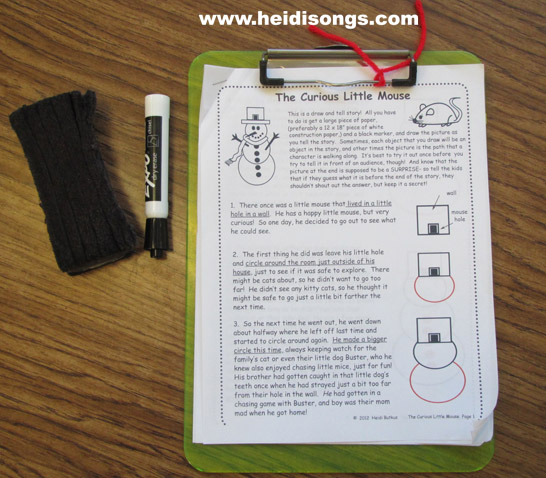
I have been wanting to write a “Draw and Tell” story for quite a while and share it on my blog, but the thing that has been holding me back is the need to break the artwork for the story down into tiny steps and save each one as a separate step.  That takes a while!  I also wanted this story to be seasonally appropriate, but not holiday oriented so that everyone might be able to use it.  I keep hearing from teachers that are unable to use any lesson plans that have a connection to a holiday, etc.  My school doesn’t have any such restrictions (at least not so far!)  Nobody really seems to care or object if the children make a Santa project or a candy cane.  BUT, I do feel bad for those of you that teach in places where that is a no-no.  So, with that in mind, I created a story about a mouse and a snowman.  Hopefully, nobody has found a reason to object to a mouse or a snowman, other than the fact that they may be a little too cute or a little too much fun.  If your administration objects to things that appear to be even a little remotely cute or fun, then when you get to the face on your snowman, draw a straight line instead of a smile, and maybe that will appease the powers that be, ha ha!  Then ask a lot of higher level thinking questions at the end of the story.  That’s always a good idea anyway, right?  If you would like to download this story, click here.  


To tell this Draw and Tell story, this is what you need:

1.  A large piece of white paper, or a white board easel.
2.  A marker.
3.  The downloadable story.
4.  Some kids to listen.  That’s it!

I always start by telling them that my story is going to create a picture, and if they guess what my picture is before the end of the story, they will need to keep it a secret and don’t tell their friends, because they might spoil the surprise for somebody else.  We don’t tell everyone what is inside a Christmas present, right?  It’s better when it’s a big surprise!  Then, each time you tell part of the story, you draw a part of the picture.  All you have to do with my story is copy the part of the picture that is printed in red.  My story forms a snowman in the end, which is supposed to be a big surprise.
Of course, two minutes into it, one little boy interrupted my story and yelled out, it looks like a snowman!  I don’t know how he could have gotten that from two little squares on a white board, but he did!  (It's possible he saw my paper on the clipboard.)  Luckily, I just shushed him, the class ignored him, and the children of course enjoyed the story anyway, despite the spoiler.


It’s best to practice telling the story once on your own without the kids, just to make sure you know what to do.  You’ll also tell it more fluently and draw the pictures a little bit better if you have done it before.  But the children won’t care if it looks rather childish.  They will LOVE it!  I find that children are usually MESMERIZED when I tell a Draw and Tell story!

I have told lots of them in the past; just never one that I have written myself.  In fact, there are whole books full of them.  One of my favorites is a Book by Richard Thompson, called Draw-And-Tell: Reading - Writing - Listening - Speaking - Viewing - Shaping.  You can find used copies on Amazon.  You just have to figure out ahead of time how each picture and story goes, because they are a bit more complicated than mine.  Happy teaching!

11 comments:

Camille said...

Thank you Heidi! I LOVE the draw and tell stories so am thrilled to have another one! Thank you also for giving me a shout out in your blog. You are soooo kind! It was really fun to meet up and get to know other bloggers. Thank you for all you share!
Love, Camille
An Open Door
http://camillesopendoor.blogspot.com/

sallytomato said...

Bless you! Thanks so much - I'm doing it on Monday.

Heidi Butkus said...

Hey, Camille! It was great to meet you, too! I had such fun!
Hugs,
Heidi

And to Sallytomato
God bless you, too!!!! Enjoy!
Heidi

quiltmom said...

Thanks for the link for the book- I found a copy available through the Canadian Amazon company. My kids like to draw and some of the ones like David were a great hit with them.
I do really enjoy your blog and using your materials. Thanks for all that you do to support the learning of young children.
Regards,
Anna

Anonymous said...

Heidi, I saw you at the kindergarten conference and purchased your sight word DVD. Which order do you introduce the words and how many at a time? I know this has probably been answered already, but I appreciate the help.

Heidi Butkus said...

To anonymous,
Hi! The best answer to this is to check the pacing guide that I have posted on my blog. I introduce the words in the general order written on the pacing guide, it's usually about two per week.
The guide can be found at this link:
http://heidisongs.blogspot.com/2010/09/fitting-it-all-in.html
I hope that helps!
Heidi

Cortney (a.k.a. Ms. Bystrom) said...

Hi Heidi,

Thanks for the draw and tell story --- I had never heard of them before today! :)

This is my first year as a reading intervention specialist and we use your curriculum. The kinder-kiddos I work with love your alphabet action video!

Any advice for a novice like me? My students are having issues distinguishing between the letters p, q, b, and d...

Thanks for all of your helpful resources!

Your new and faithful follower,
Cortney
onceuponasubstitute.blogspot.com

Heidi Butkus said...

Hi, Cortney!
I'm glad to have another "new and faithful follower!" :)
Gosh, learning to distinguish between the letters b, d, p, and q is a matter of developing visual perception. Children grow out of this in time. Those that do not have real problems, such as dyslexia- at least this is the way I understand it. I do invite anyone out there to correct me if they know differently!
I heard a workshop once in which the teacher said that she drew "fur" (some little lines) on the back of the lower case b's for her students in all of their little books so that the letter would look different from the d. She told them it was the "back of the bear." She had even made a font with lines on the back of the b's so that she could type up her own little stories using it. She liked it because it totally eliminated the confusion between the b and the d, at least in her printed materials. It was enough to get them through her reading lessons anyway.
Then the lower case q had a little stick on the bottom, which made it look a little different from the p, so that always helped a little.

I wish I knew some other ways to help. If anyone else out there knows of some other ways to help boost and develop visual perception and minimize reversals, can you let us know? Thanks!
Heidi

Cortney (a.k.a. Ms. Bystrom) said...

Heidi,

I was on pinterest and found this wonderful p/d/q/p reversal song! The printables offer great visuals too. Example: bat the ball makes a b! or doorknob opens the door for a d! ;)

http://www.teacherspayteachers.com/Product/b-and-d-Song-AND-p-and-q-Song-Helping-Children-Learn-the-Difference

Thanks for the thoughtful advice,
Cortney
onceuponasubstitute.blogspot.com

Doodle Bugs Paper said...

Love Love Love this!!!

Carissa said...

I LOVE Draw and Tells! I use them even with my upper level students to have them practice predictions or transition words. More ideas here:
http://eslcarissa.blogspot.mx/2012/06/tell-and-draw-stories.html